SCC Magazine – Best 10 Used Car Buyer’s Guide – 323GTX
The crew SCC magazine told me they were putting together a 10 best used car buys guide and asked for our input on the Eclipse and the GTX. Here is the GTX article:
Sport Compact Car Magazine – December 1998
By Dave Coleman
Reprinted with permission
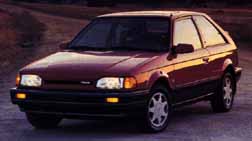
What would we do without rally cars? To be considered a production car for Group A rallying the FIA mandated that 5,000 road-going versions of that car had to be built. The 323 GTX, like most of the world’s coolest cars, was built for production to homologate the all-wheel drive turbocharged 323 as a legal, production-based Group A rally car. The 323 GTX first appeared in Europe and Japan in 1986, but didn’t make it to our shores until 1988,when Mazda was trying to bolster the image of their rather pedestrian 323. Over its two year run in the United States, only 1,243 were sold, making It difficult to find one now but not impossible. If you can locate a GTX, its relative anonymity translates into a remarkably low resale value.
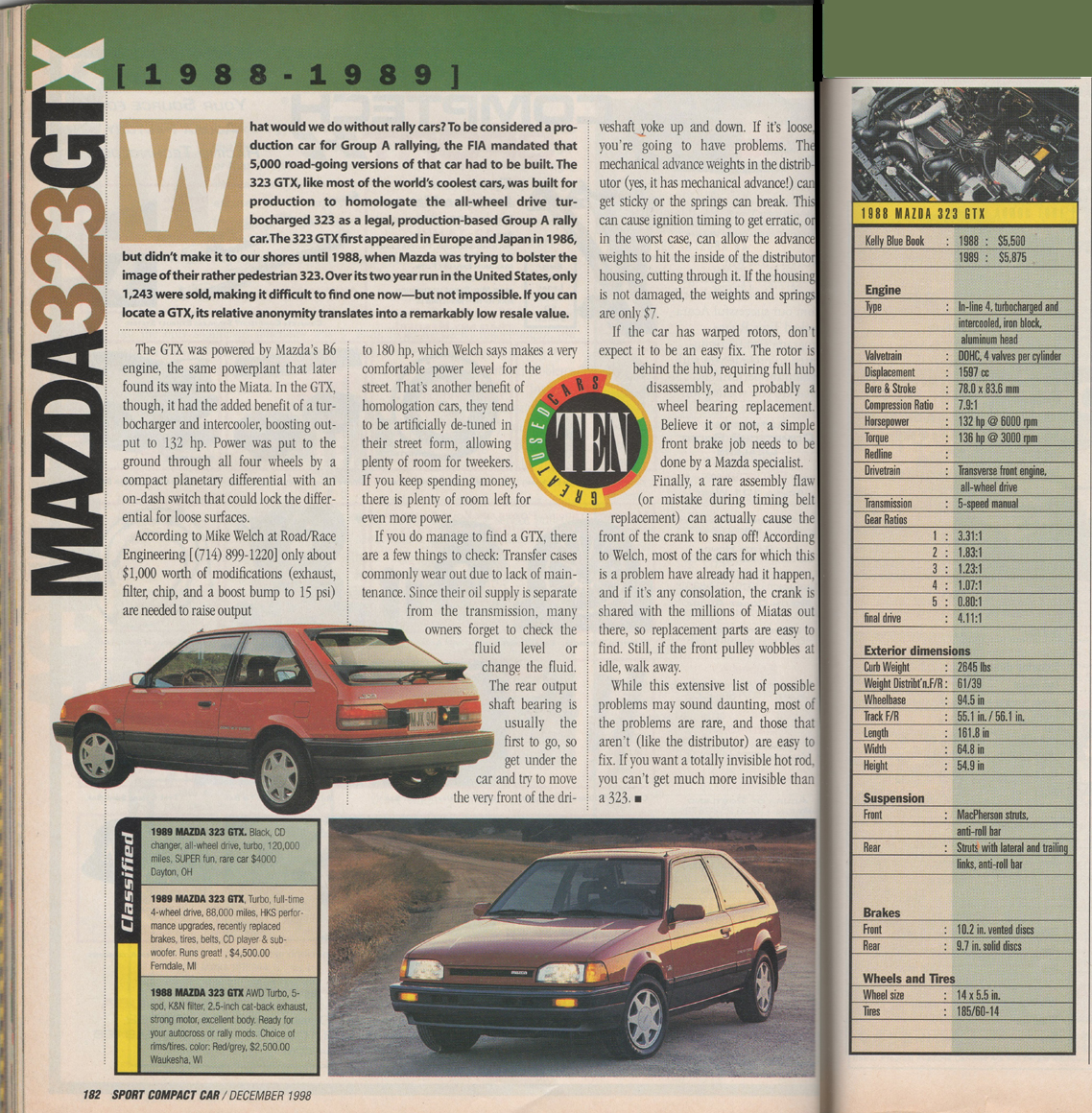
The GTX was powered by Mazda’s B6 engine, the same power plant that later found its way into the Miata. In the GTX, though, it had the added benefit of a turbocharger and intercooler, boosting output to 132 hp. Power was put to the ground through all four wheels by a compact planetary differential with an on-dash switch that could lock the differential for loose surfaces.
According to Mike Welch at Road/Race Engineering [(714) 899-1220] only about $1,000 worth of modifications (exhaust, filter, chip, and a boost bump to 15 psi) are needed to raise output to 180 hp. which Welch says makes a very comfortable power level for the street. That’s another benefit of homologation cars, they tend to be artificially de-tuned in. their street form, allowing plenty of room for tweakers. If you keep spending money, there is plenty of room left for even more power.
If you do manage to find a GTX, there are a few things to check: Transfer cases commonly wear out due to lack of maintenance. Since their oil supply is separate from the transmission, many forget to check the fluid level or change the fluid. The rear output shaft bearing is usually the first to go, so get under the car and try to move the very front of the drive shaft yoke up and down. If it’s loose, you’re going to have problems. The mechanical advance weights in the distributor (yes, it has mechanical advance!) can get sticky or the springs can break. This can cause ignition timing to get erratic, or in the worst case, can allow the advance weights to hit the inside of the distributor housing, cutting through it. If the housing is not damaged, the weights and springs are only $7.
If the car has warped rotors, don’t expect it to be an easy fix. The rotor is behind the hub, requiring full hub , disassembly, and probably a wheel bearing replacement. Believe it or not, a simple front brake job needs to be done by a Mazda specialist. Finally, a rare assembly flaw (or mistake during timing belt replacement can actually cause the front of the crank to snap off! According to Welch, most of the cars for which this is a problem have already had it happen, and if it’s any consolation, the crank is shared with the millions of Miatas out there, so replacement parts are easy to find. Still, if the front pulley wobbles at idle, walk away.
While this extensive list of possible problems may sound daunting, most of the problems are rare, and those that aren’t (like the distributor) are easy to fix. If you want a totally invisible hot rod, you can’t get much more invisible than a 323
Engine Type : Inline 4, turbocharged and intercooled, iron block, aluminum head
Valve train : DOHC,4 valves per cylinder
Displacement : 1597cc
Bore and Stroke : 78.0 X 83.6 mm
Compression Ratio : 7.9:1
Horsepower : 132 @ 6000 rpm
Torque : 136 hp @ 3000 rpm
Drive train :Transverse front engine, All wheel drive
Transmission :5-speed manual
How do you tell if it is a GTX by looking at only the VIN number ?
There are 17 numbers in the (USA) VIN numbers
Example:
JM1 BF 23 4 7 J 0 100001
The first three are the World Manufacturer Identifier
JM1 is for Mazda’s US and Canadian cars.
4th and 5th characters are the car line series
BF is for the 323 (in 88-89)
6th and 7th are is the body style code
22 is 4 door – 23 is 3 door hatch back – 34 is hatch back
8th is the money code number
2 is 1600cc EFI 2WD
3 is 16oocc DOHC Turbo 2WD
4 is 16oocc DOHC Turbo 4WD
The ninth digit is a check number from a mathematical formula
Keeps you from making up your own number.
10th digit is the year code
J is 1988 – K is for 1989
11th digit is the assembly plant
0 is Hiroshima
12th thru 17th is the production serial number
You want the 8th digit to be a “4” for a GTX

SCC Magazine Eclipse Project – MORE OF EVERYTHING
Sport Compact Car Magazine, Dec 1998
by Dave Coleman
ALL the stuff we want to do, but never did
When asked by passers-by on the street what we have done to our Project Eclipse, we often settle for the short answer: “Everything.” As it comes time to say good-bye to our Eclipse GSX, though, everything just doesn’t seem like enough. While we have undeniably elevated our car’s performance to a new level, we can’t help but keep looking up for more. Our Eclipse’s last track session brought to light several of the car’s remaining weaknesses, most of which aren’t inherent weaknesses in the car at all, but problems we inflicted on the car by raising performance levels elsewhere. Following are the areas most in need of further improvement, and what we would do about it if we had the Eclipse for another year.
Brakes: Our quest for power was so intense that we completely neglected the brakes. As a result, we managed to destroy the front pads in the 22,000 miles that we had the car. The final sure sign that our car was under-braked for its power and weight came in the last six laps made during our last track session. It was after our photo session was done, and just after the sun had gone down. With a day’s worth of lapping under our belt, feature editor Josh Jacquot and I headed out for some last minute banzai laps to establish exactly what our Eclipse was capable of on the Streets of Willow for an upcoming story.
High beams glaring, I headed out first while Josh timed laps. After three laps pushed to the limit, I pulled in and traded keys for a stopwatch. It was then that I noticed the front rotors glowing a crimson red more stunning than the recent sunset. They reached this state after less than 3 miles of hard driving!
Josh headed out for a slow lap to cool the brakes, followed by three more laps driven in anger (Joshes laps were slightly slower than mine, of course, a fact he blames on the brakes, but which was obviously a matter of driver skill). By the end of this abuse session, the brakes’ glow was casting eerie red shadows of our Kosei wheels onto the track, and the spine-grinding metal-on-metal sound of the wear indicators dragging on the rotors accompanied the car’s every movement.
The solution? We recently drove Mitsubishi’s Eclipse Speedster show car that is essentially a mildly modified GS-T Spyder. That car was fitted with massive Baer Racing brakes up front, and 300OGT brakes in the rear. The pedal feel afforded by the massive four-piston calipers up front was another world compared to the mush of our stock brakes’ and the 13-inch rotors would surely hold up to our abuse much better than the 10.8-inch stockers. if only we could have kept the car
Alignment: The other casualty of our late night track attack was the tires. The inside edge of our 225/40-18 Dunlop SP9000s left the track looking like a cross section of the tires’ construction, with several layers of belt showing all the way around the tire. Such hard driving should have worn the outside edge of the tire, but excessive negative camber kept the inside edges overloaded The Eclipse’s double wishbone front suspension has a fairly aggressive camber curve to keep the outside tire upright while the body rolls in a turn. When we lowered the car, we not only reduced body roll by lowering the center of gravity and increasing the spring rate, we also put the suspension into a steeper part of its camber curve. The result was too much work for the inside edge of the tire, and not enough for the rest of it.
The solution? Ingalls Engineering offers a camber adjusting kit that allows you to adjust camber by up to one degree in either direction. Though not a huge range of adjustment, one degree would certainly help our problem. If only we could have kept the car..
Anti-roll bars: With all this talk of how reduced body roll contributed to our tires early demise, it may seem surprising to find anti-roll bars on our wish list. We have good reason to want them though. The Eclipse has very little suspension travel even in its stock form, and lowering the Car has only worsened the problem. While the Eibach springs and Koni shocks work well to keep the suspension off the bump stops in a straight line, body roll compresses the outside suspension, reducing the amount of travel left for soaking up imperfections in the road or track. We felt the bump stops more than once during our day at the track, and the increased cornering grip we would get from correct camber settings would only make matters worse.
Besides letting the suspension do its job, a proportionally larger rear anti-roll bar would increase the cornering burden borne by the rear suspension, thereby reducing understeer. In stock form, or with our current suspension setup, the Eclipse has a very nose-heavy cornering attitude. Getting the rear wheels to come around requires an inadvisable and unproductive amount of trail braking. The handling limits and driving enjoyment could be heightened by getting the rear wheels more involved.
The solution? Suspension Techniques is just finishing up a stiffer set of anti-roll bars for the Eclipse GSX (the GS-T set is already available) and they should be done by the time you read this. Too late for us. If only we could keep the car..
Intercooler: All of the estimated 300 hp we are making is being generated with the tiny stock intercooler. The dramatic difference between the car’s performance on a cool morning and on a hot day only serves to demonstrate how critical charge air temperature is to making power. From the beginning of the project we had planned to use a front-mounted GReddy intercooler. When it turned out that installation would require minor trimming of the front bumper and some plastic trim panels, the intercooler was ruled out.
The solution? Trim the bumper anyway! If only we could have kept the car..
ECU reprogram: Also remarkable is the fact that our estimated 300 hp is coming from the stock ECU, with adjustments for the larger injectors and increased boost being made simply by fooling the ECU with altered air mass sensor inputs from an Apex Super AFC. While this effectively moves the fuel and ignition outputs to more appropriate portions of the stock maps, it cant fix a bad map. The Eclipse ECU is full of “bad” maps, with several different fuel and ignition maps to pull from depending on how close the ECU thinks you are to damaging the engine. While this does help to keep things safe it also cripples power output.
The Solution? G-Force Engineering offered to reprogram our ECU, eliminating all those “bad” safety maps, and creating new maps more appropriate for our state of tune. To be safe, though, we wanted to tune the ECU as a last step, lest further modifications made our new map less than ideal. We neglected one simple fact, though. There’s no such thing as the last modification-there’s always more to do! if only we could have kept the car..
Interior: The last flaw on our corrective wish list is an inherent problem with the car. Tall people don’t fit. For some reason, Mitsubishi designed the interior with tons of leg room, very little head room, and no room under the steering wheel for heel-and-toe knees (similar to knobby knees, but more effective on the track). Even more problematic are seats that don’t have enough lateral support. Despite looking decidedly racy, the Eclipse’s seats are upholstered in slippery leather, and have small bolsters that are too widely spaced for the relatively narrow hindquarters of our staff. The problem is only exacerbated by the fact that our taller staffers have to lay the seat back to full cruisin’ tilt just to keep their greasy hair off the headliner.
The solution? Ever since driving Mitsubishi’s SST show car (July, 1998) we have been lusting after the Recaro seats in that car. While we may or may not be able to mount those seats any lower than the stock ones, the increased side support would at least allow us to corner without using the steering wheel as a grab handle. The other part of the solution would be a smaller steering wheel perhaps a Nardi similar to the one in the Impreza WRX-that would give our legs a little more room for heel-and-toe gyrations. If only we could… well, you get the idea.
Stock vs. Modified… An Owners Perspective
As automotive journalists, those of us at Sport Compact Car are more apt to have highly opinionated views on the cars we drive than the average car nut, After all, most of us chose this line of work because we love cars and can see merit in just about anything with four wheels. Project Eclipse seems to stir the pot of opinions here at SCC in a way that few other cars do-both good and bad. Some staffers love the car for its ultra-aggressive looks, some think it’s just too numb to ever be a real drivers car; and Others think it’s too much for the street and physically demanding. There is, however, one opinion that remains constant throughout the staff no matter who you ask This is one damn fast car!
Project Eclipse is an especially interesting endeavor for me due to the fact that for more than a year now my personal choice for transportation has been the Eclipse’s mechanically identical twin brother, a ’97 Eagle Talon TSi AWD. This gives me what I hope is a fairly unique perspective on the changes and improvements made to the car since SCC began the project in the November 1997 issue. My car is bone stock right down to the factory air box and offers a perfect test bed to make performance comparisons against Project Eclipse.
I’ll begin with drivability and horsepower improvements since these were the primary focus of the project There is almost no similarity between the results of opening the throttle on the stock car and mashing the go pedal on Project Eclipse. As noted during the car’s buildup, one of the main drawbacks in the stock car’s engine is its inability to make power beyond about 5500 rpm. This really isn’t a concern if one hasn’t driven a modified Diamond Star car-after all, they do make more than 200 hp. But after spending much quality time in Project Eclipse, the differences are too great to ignore. Don’t take this wrong, the stock car feels wonderful providing the desired turbocharged snap one expects without being peaky, just the improvement Mitsubishi wanted after the first-generation cars. Project Eclipse, at about 18 psi boost pressure, provides considerably more initial punch on spool up and will then pull hard past redline if not carefully driven. So dramatic is the improvement that it doesn’t even feel like the same power plant.
In the suspension department, the Project car is simply a more grown up version of the car I’ve come to love during the last year. Bigger wheels and tires combined with progressive-rate springs and adjustable shocks bring handling to a level not wisely explored on the street. Even the stock car will comer hard enough make one question his or her sanity, begging the driver for more throttle anywhere in a corner While the most noticeable improvement in Project Eclipse from stock is the near absence of body roll, grip is overwhelmingly improved and most noticeable at high speed despite the car’s hefty 3,157 lb weight. About the point when the stock car feels ready to lean over and touch the ground is when the Project Eclipse driver dials in more throttle.
As the He-Men of modified import cars, modified Talons and Eclipses are just not easy to drive smoothly relative to others in their segment. When driven on the street the car is very much a workout. Gone are the respectable pedal feel and long, easy throws of the stock car’s controls. The most noticeable difference is certainly its high effort Exedy clutch. Having been given the privilege of driving the car during the necessary break-in period, I have to say it was not easy-especially in the inevitable Los Angeles-area traffic jams. Spending an hour with this car in traffic can be likened to going a few rounds with a Stair-master set on Mt Everest mode-difficult to say the least
That’s the great part about Project Eclipse the problems this car has when dealing with around-town driving are what make it shine on a racetrack. The high effort clutch warms tip and works wonderfully, thriving on the heat generated during aggressive driving-something the stock unit never would have survived. Even the short-throw shifter, despite its stubbornness, improves the car’s track driveability. The real drawback of the Eclipse is its overabundant bulkiness-its weight hurts braking distances and makes it much harder to manage than lighter machines.
A recent day at the Streets of Willow Springs racetrack provided the necessary space to really let the car stretch its legs. My favorite trait of a stock Eclipse or Talon is it’s neutral, nearly stupid-proof nature when pushed to the limit. Project Eclipse has simply raised the limit of the stock car, taking the platform’s already good manners and making them even better. While there is no companion to be made between the power of the stock car and the project car, their handling traits are remarkably similar. Characterized by easily controlled understeer, both cars require either a major brain failure or an act of God to spin out. Get into the throttle and both cars will progressively increase understeer, back out and both come back on line. Granted, all this happens at a much higher rate of speed and g-load in the modified version. The project car can be sent slightly sideways under heavy trail braking, but rights itself instantly and comfortably to a neutral attitude before its driver can enjoy power-on oversteer. Darn it. The only way to get the stock car sideways is immediately after rain has started to fall on a greasy road surface or by going crazy in the gravel. in other words, these cats weren’t meant to be driven sideways with their open center differential.
The best part about Project Eclipse is that, despite its many mods, there is still plenty of room for improvement. It’s amazing to think that a car this capable can actually have so many areas left to improve.
Sadly, our time with Project Eclipse has come and gone. I’d like to make Mitsubishi come and peel the Eclipse keys from my fingers but luckily I’ve got its brother in my garage at home.
INSTALLMENT NO. ISSUE DATE SUBJECT
1) November, 1997 Suspension, stage I engine mods
2) January, 1998 Apex electronics (AVC-R, AFC, Turbo Timer, Boost Gauge)
3) March, 1998 Turbonetics T-28 turbo upgrade
4) September, 1998 HRC downpipe/catalyst, Road/Race fuel pump, RC injectors
5) November, 1998 Exedy clutch. fuel system tuning
SCC Magazine Project Eclipse – Final
Mitsubishi Eclipse GSX Part Six
Time To Say Goodbye
By Kieth Buglewicz
Reprinted with Permission

It’s not like we didn’t know it was going to happen, It never really belonged to us, despite how close we had gotten to the car. No, our long-term Mitsubishi Eclipse was ultimately, a short timer. But in the year (plus 3 months, thanks to Mitsubishi’s benevolent PR king Kim Custer) we had the car, we had more fun than is probably legal, were able to cram a good amount of performance under the hood, and discovered at the end that it, indeed, all work as advertised.
This speaks volumes for the versatility and flexibility of Mitsubishi’s 2.0 liter turbocharged four cylinder. But despite our efforts, we could have done more. The brakes were still stock. The engine itself had never been opened, so there was room for porting and polishing. The car desperately needed an upgraded intercooler. The list goes on practically forever, and you can see what else we would have done if we could have kept the car longer by checking out Dave Coleman’s sidebar.
Rather than express a wish list, I’m here to recap what we have done, and try to keep emotion out of it.
We got the Eclipse in May of 1997 with a scant 26 miles on it. It was, however, a case of the third time being charmed, as we had gone through two other cars previously. Our first car was virtually identical (it had a brown interior) and was pulled from Mitsubishi’s press pool. However, after a week with the car, an ugly problem reared its head: The transmission was making horrendous gronking sounds in first gear at full throttle. We returned the car, and were told it was actually a pre-production vehicle that had already had the transmission replaced. We were asked if we would like a brand-new car built especially for us at Mitsubishi’s Normal, 111. plant. Not being stupid, we said yes.
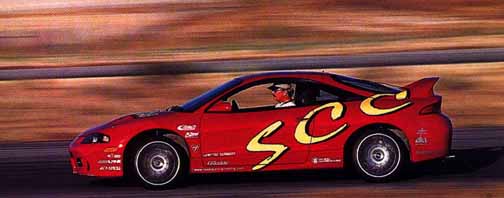
After a week . . . The transmission was making horrendous gronking sounds in first gear at full throttle.
The second car we never actually saw. After about a month of waiting (not unusual for a special order), it showed up in April. We got the call from Steve Kosowski (also of Mitsubishi PR) that our new baby was delivered…but there was another problem. Somewhere, somehow, despite the fact that Steve wrote on the order form that we wanted a five-speed manual transmission (he showed us the form), the car arrived with an automatic. Crap.
Since, as everyone knows, an automatic transmission in a car like the Eclipse would be just as useful as training wheels, we agreed with Steve’s suggestion that the plant build us another car. One month later, it arrived. Steve told us it wasn’t quite to spec either, as it had a gray interior rather than a brown and black one. Gray, brown, black, lavender…as long as all the big mechanical bits were in place, we were happy.
It didn’t take long for us to break in the car After an oil change at 500 miles, and another at 1,000, we were ready to play. One thing had become apparent to us almost immediately: If we had looked at the order form more carefully, we would have skipped the sunroof. This is advice anyone over about 5 feet 11 inches tall should take to heart. The seating position was also uncomfortable for tall people because of the low slung steering wheel. Even at its uppermost adjustment, it was in the way Incidentally, aside from amputees, I can’t imagine who would set the wheel at its lowest setting; the wheel almost completely blocks access to the pedals.
Despite having to adjust ourselves to sit in the car, we were impressed by its power and grip. But the break-in period also allowed us to determine our first course of action. One of the first things that drew attention to itself was the suspension. The Eclipse is no light weight ours weighed in at more than 3,500 lbs with two people on board but its strong motor makes up for it by yanking the car around at a good clip. The suspension is stiff enough to stick the car in a turn, but soft enough to let the heavy body gently bob up and down on fast sweepers. You never feel like the car is going to fly out of control, but the feeling is a little unsettling. We decided to upgrade not just the springs, but the shocks as well to give us the handling we wanted. We opted for Eibach’s Pro Kit springs along with Koni’s s adjustable shocks.
Not only did the suspension mods work, but the incremental lowering job (only about an inch all around) hunkered the car closer to the ground, making it look like a badger: Low, wide, and always angry about something. Naturally, the suspension mods made the car much more capable than its stock tires (lackluster Goodyears) could handle. So we upgraded to 225/40ZR18 Dunlop SP9000 tires. They proved to be a good choice, with very good dry grip and virtually untouchable wet grip. Coupled with the all-wheel drive character of the Eclipse, this was one sports car that was unafraid of the rain.
The second thing we noticed about the car in its stock form was that after an initial surge of boost, power would start to fall off at about 5500 rpm. Frankly, revving the engine to its 7000 rpm redline was fruitless: The engine only produced noise after about 6200 rpm One glance at the engine bay and it was clear the anemic stock intake and exhaust were to blame. We installed a HKS cat-back exhaust system, which produced the expected exhaust note for an Eclipse: A loud farting blat. On the intake side, we installed a K&N intake, a GReddy blow-off valve, and a Road/Race Engineering intercooler pipe.
Mike Welch at Road/Race is well known in the Eclipse community as a guy who seems to have an unhealthy amount of knowledge about these cars. If he could, I’m sure he’d sleep with one under his pillow. But that knowledge made him our unofficial Project Eclipse Performance Guru, and we turned to him for just about every question we wanted answered. Opening up the intake was his first suggestion, and he let us in on a secret that is often overlooked. The stock blow-off valve feeds back into the intake pipe. This keeps the computer happy, since it has already measured that air with the air mass sensor. To keep noise levels down though, the blow off valve dumps into a four-inch long dump pipe that extends far down into the intake hose.
Not only did the suspension mods work, but the lowering job (only about an inch all around) hunkered the car closer to the ground, making it look low, wide, and always angry
What this means is that although the intake pipe looks big from outside, it is significantly blocked by the dump pipe. Mike’s solution to this intake blockage is simple: Cut the return pipe out. It doesn’t actually make a lot of power, but it adds to the responsiveness of the engine. The gains were immediately apparent. The car built boost much more quickly and held it much longer, making power almost all the way to redline.
Mike’s solution to this intake blockage is simple: Cut the return pipe out. It doesn’t actually make a lot of power, but it adds to the responsiveness of the engine
Making performance modifications to our car presented us with the problem of quantification. We needed to demonstrate that our Eclipse felt faster because it was, not because we could hear the whoosh of the turbo and the flatulent exhaust note more clearly after our mods. Luckily, we had a solution to getting “dyno” results from our Eclipse in the form of our Vericom 2000 performance computer.
In an oversimplification, the Vericom is essentially an accelerometer. By measuring how quickly a car accelerates in a certain gear, then plugging in weight, ambient air temperature and other factors, one can calculate how much power the car is making. The results were consistent enough for us to publish, as long as we tested back to back each time (the Vericom turned out significant fluctuations depending on air temperature). The result was a solid 30-hp increase for slightly less than $1,000 worth of parts that would be easy to install for even a mediocre mechanic.
Naturally, we wanted more power. So we decided to turn up the wick with more boost. This produced cries of “You’re gonna kill it!” from our photo editor, Les Bidrawn. Multiple assurances couldn’t dissuade him: He was certain we were about to murder our car.
Flush with our early success, we figured that just by wiring in an Apex boost controller and fuel computer, turning the boost up to about 17 psi and hitting the streets, we’d be flying fast. And we were right, to a certain extent. The boost controller fattened the midrange power significantly, but was unable to hold boost very long after about 5000 rpm. We had run up against another wall, although far earlier than we had anticipated. We turned to Road/Race for an answer.
The stock turbo, as it turns out, is barely adequate for the stock engine’s needs. Although the Eclipse is rated at a peak boost of 14 psi, it holds this only for a few hundred rpm before boost falls off to about 9 psi by redline. Part of the problem is with the crummy stock blow off valve, which has virtually no method of sealing against its seat, and has a spring so weak it can be pushed down with your pinkie. We replaced that in step one, but still had boost problems. We thought that by adding a boost controller, we would be able to hold boost to redline.
In the mean time, we had moved the Apex turbo timer, fuel computer and boost controller to the center console. Although the stock stereo sounded great, it was removed for our surgery. Replacing it was an Alpine three disc in-dash CD changer. The sound was great, and the unit was loaded with features. Competition Soundworks in Cerritos, Calif. did the installation work, and we undertook mounting the Apex gear under the Alpine unit ourselves. The result looked great, and was much more ergonomic.
The next step in our upgrade was the most drastic. Most Honda and Acura drivers would suggest the very popular T3/T4 hybrid turbo. However, that particular turbo requires significant heat shielding to prevent it from melting the air conditioner fan. Instead, Turbonetics in Moorpark, Calif., set us up with an upgraded version of the stock turbo. Since we were only planning to run about 18 psi of boost, the modified stock turbo would be more than adequate. We also had a couple other concerns, mainly that the car was driven daily, and we wanted a turbo that would give us the power we wanted without excessive lag. We also wanted something that would be reliable, for the same reason. Longevity was the key, and since the car did eventually have to go back to Mitsubishi, we wanted to return a working automobile, not a car-shaped pile of non-working parts.
Turbonetics modified the turbine and compressor housing of a stock Eclipse turbo to accommodate larger wheels. This in turn allowed the turbo to flow more than 30 percent more air without significantly increasing lag, an advantage we probably would not have had if we went to a physically larger unit. We once again turned to Road/Race Engineering for installation, where Mike had a suggestion for improving flow. A ported exhaust manifold, he said, would significantly aid flow to the turbine, as would porting the huge cast iron exhaust flange from the turbo to the exhaust down pipe. The result was much snappier throttle response, gobs of midrange power, and virtually no lag whatsoever.
But the high end was still falling off boost, regardless of the new turbo. One culprit we thought might be to blame was the fuel system. After we installed the turbo, the fuel cutout would abruptly shut off the fun in cool weather (when the intake charge was most dense). The car felt like it hit a wall each time it happened, and also made the check engine light come on for the first time (it also had us wondering if, after all, Les had been right). To cure the problem, we installed a set of 550 cc injectors from RC Engineering next, as well as a higher capacity fuel pump and exhaust gas temperature gauge to properly calibrate the Apex fuel computer. We also installed a 3inch stainless steel, mandrel bent downpipe from Hahn Racecraft and a 3-inch catalytic converter to remove the final obstructions from our exhaust system.
We once again succeeded in improving mid-range output, with another incremental gain at the high end. But at last, we found why top end power had been so elusive. While he was tuning the fuel compute; Mike Welch noticed that as he data-logged speed and rpm, the two would increase at the same rate (as they should) through the middle of the rev range, but at high rpm the engine would start accelerating faster than the car! There was only one answer: The stock clutch was being overwhelmed at high engine speeds when the turbo was at full song. The fix came in the form of a three-puck Exedy clutch.
Flush with our early success, we figured that just by with In an Apex boost controller and fuel computer, turning the boost up to about 17 psi and hit the streets, we’d be flying fast. And we were right, to a certain extent
Man, did it work. Finally, the top end acceleration matched the low- and mid-range surge. The engine held boost now to redline, and the car felt like we had installed an afterburner instead of a clutch. No sooner was the clutch installed than we took the car to the Streets of Willow at Willow Springs Raceway in Rosamond, Calif., for a little testing. The new clutch demanded respect, requiring good matching of revs at every shift to avoid a lurch when the clutch grabbed…and grabbed hard. But driven even moderately well, the Eclipse screamed around the track. Far from lithe and nimble, the GSX felt like it made its way around the track by getting the pavement in a death grip and bullying its way through the laws of physics. Driven full bore, the Eclipse could dive into each corner with the ABS pulsing like mad, fight its way to the apex, and then spit the corner out behind under full boost. Powering out of the corner was always the most difficult part, as terminal understeer was often the result when a surge of boost felt like it was lifting the front wheels and pushing them sideways. Extreme understeer would make the out side front tire chatter across the pavement a very unsettling feeling but if you balanced steering input correctly on the exit, the Eclipse was extremely fast. Of course, all this brute force did take its toll on the brakes and tires, but it sure was fun!
Far from lithe and nimble, the GSX felt like it made its way around the track by getting the pavement in a death grip and bullying its way through the laws of Physics
Which more or less brings us to where we are today, returning the car to Mitsubishi. During its time with us. The Eclipse appeared at numerous event, including the 1997 SEMA show in Las Vegas, the 1998 SEMA Import Auto Salon and the 1998 Long Beach Grand Prix. Not to mention the numerous local drag races and car shows. With its wild graphics scheme (courtesy of Imagine It Graphics), the Eclipse excelled at attracting attention. Which, of course, was sort of the whole point.
So, we bid farewell to the Eclipse, impressed with its performance potential and with the fact that nothing ever broke, despite everything we threw at it (a worn clutch doesn’t count). What the future holds for Mitsubishi’s sporty coupe is truly unknown at this time. We’ve heard rumors that the turbocharged 2.0-liter motor will disappear with this particular model, replaced by the new 3.0-liter V6 found in the ’99 Galant. With 195 horsepower, this would not necessarily be a bad thing. On the other hand, we’ve also heard that the turbo motor may make a return. You can expect all wheel drive to bid a final farewell: Mitsubishi sells very few turbocharged models, and even fewer GSXs.
| What it Cost | |
| Suspension | |
| Springs: Eibach Pro Kit | $225 |
| Shocks: Koni | $576 (set of 4) |
| Wheels: Kosei Seneca 18 x 8 in. | $420 (each) |
| Tires: Dunlop SP9000 225/40ZR18 | $228 (each Tire Rack Price) |
| Engine | |
| Exhaust: HKS | $480 |
| Turbocharger Turbonetics T28 upgrade | $850 |
| Intercooler Pipe: Road///Race | S90 |
| Blow-Off Valve: GReddy Type S | $205 |
| Intake: K&N | $95 |
| Fuel Computer: Apex Super AFC | $369 |
| Turbo Timer: Apex | $99 |
| Boost Controller: Apex | $579 |
| Sound System: | |
| 3-disc in dash head unit: Alpine 3DE-7886 | $480 |
| Speakers: Alpine SPS-1326 | $80 |
| INTERIOR: | |
| Short Shifter: Pace Setter | $190 |
| Shift Knob: RAZO | $85 |
| Pedal Pads: RAZO | $77 |
| EGT Gage: Apex` | $211 |
| Boost Gage: Apex | $170 |
Tree Line SCCA Pro Rally Azusa Canyon – Results
Hi Everyone,
We are back from the rally, Good news.
Tony Chavez in his GVR-4 Rally car won his first Pro
Rally over all. He has won his class before in his old
Golf and FWD Eclipse but this is his first overall win.
On the first leg (three stages) up the mountain to Mt
Wilson, Chavez lost a little time with a loose I/C hose.
He was 30 seconds behind Lauchlin O’Sullivan in an
Audi Quattro. Ron Wood (Audi Quattro) broke
a rear axle and had to go on with 3WD. Rui Brasil’s
Audi Quattro hit something and lost a lot of time driving
with about 5″ of toe-in.
On the way back down the mountain Chavez won
every stage. There was a lot of hugging and kissing
going on when he got in and realized he had won.
Chavez is now running 2G 8.5 pistons, a 2G ported head
on a early 1G motor, a 1.6 Mirage Turbo intake manifold
(2G size w/1G coil mounting) and 1G automatic cams.
He has a VPC/AFC, 550cc injector combo with a
TDO-5 16G 8cm turbo. He uses a Starion I/C. We tried
to set it up as the ultimate all around bottom end-top
end motor.
Paul Timmerman’s 323 GTX broke the transmission on the
first stage. Possibly it was damaged 2 weeks ago when
he rolled the car testing.
Bruce Brown’s 323 GTX ran fine with no problems and
he finished 3rd in AWD Open class.
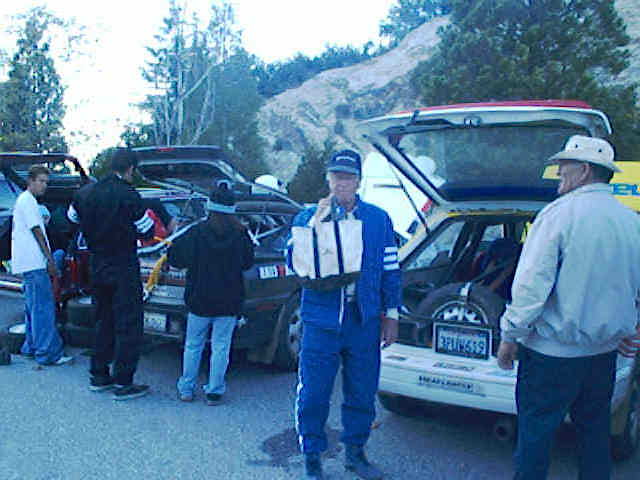
Bruce was really proud of his Rally Bag
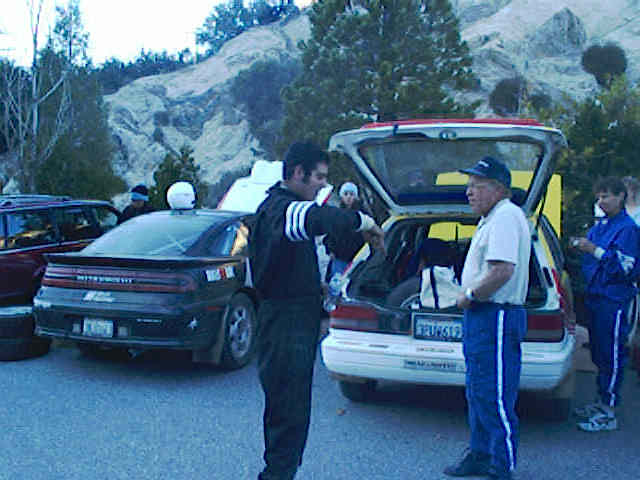
Robert Garcia ran his FWD Laser with Tony Vu as his
Navigator. When he came into the service area, Tony
looked glad just to be alive. The front of Robert’s
bumper was smashed into the skid plate so I asked
Robert what he hit. “Everything” he said. I guess they
spent some time stuck on a berm almost hanging over
a big drop off. Some workers helped get them going
again. Robert finished 3rd in 2WD Open class even with
getting stuck.
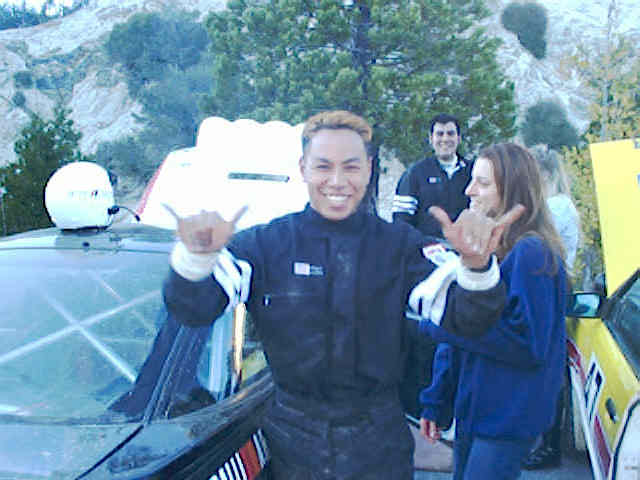
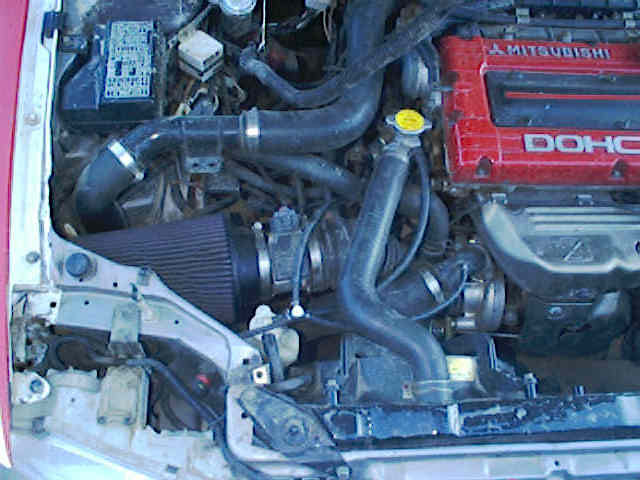
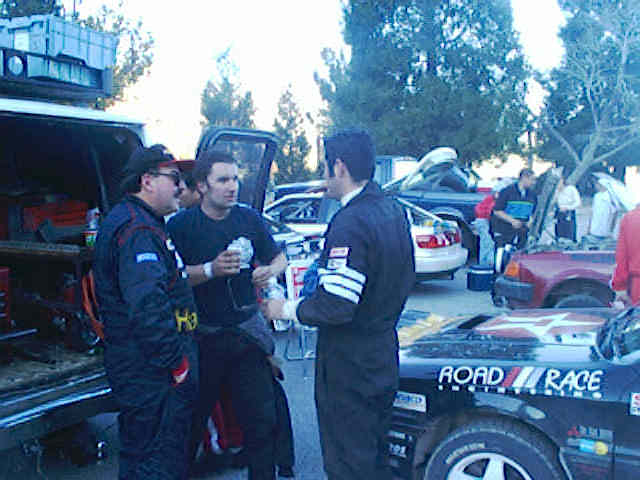
Robert Tallini hurt his back at work and was not able to
drive his Corolla GTS. Lu Ryba (he does a lot of the
fabrication here at the shop) rented the car for his first
time rallying. He has a lot of experience in SCCA Pro
Racing and IMSA road racing, this was his first time
playing in the dirt. His wife navigated for him but got
car sick on the 3rd stage. He lost some time driving
solo and ended up with a respectable 2nd in 2WD open.
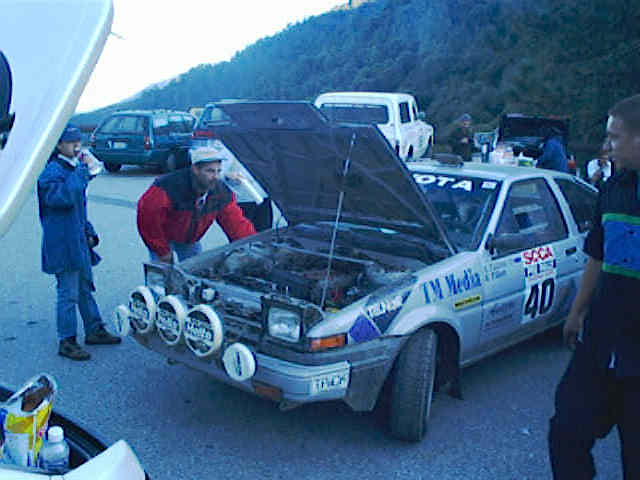
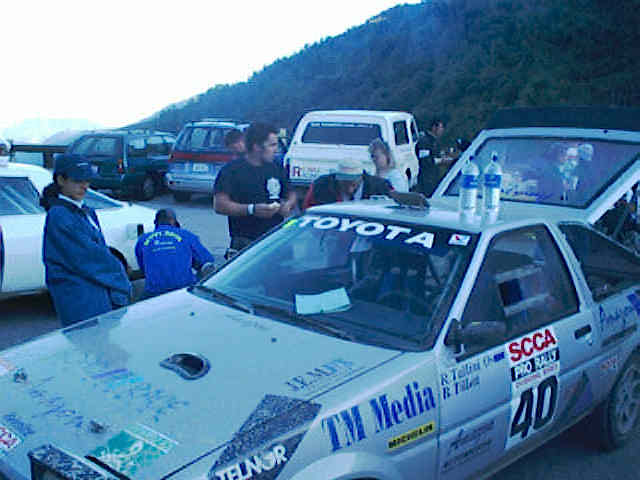
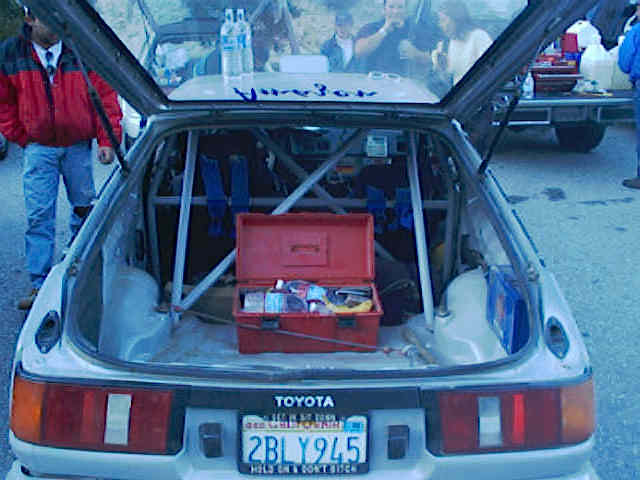
Robert Shibao got booted out of Stock class because
the guy that owned the car before him had installed an
adjustable rear brake bias control. That meant he had
to run his Mazda GLC against RX-7s, Robert’s FWD
Laser Turbo, 1.6 Corolla GTS’s, and a Saab Turbo.
Well Robert must turn into some kind of Incredible
Hulk when he drives because he ended up with 1st in
2WD open class. This is a 1.5 liter, carbureted, 8 valve
old POS ! The only mods he has is a head he ported him
self here at the shop, a Mutiny cam, and a straight
exhaust. His navigator Matt must have been pedaling too.
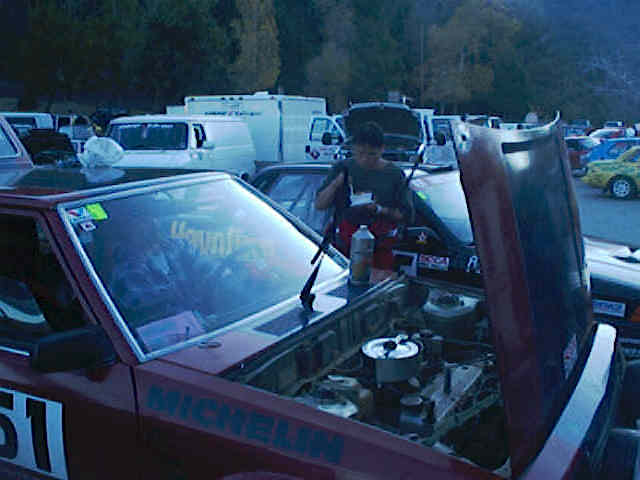
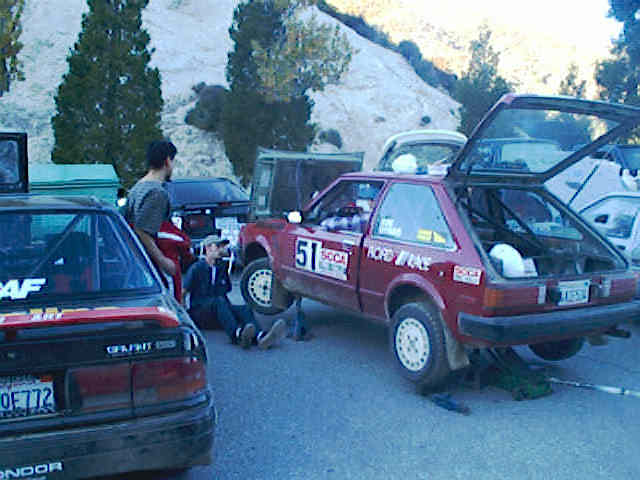
We ended up with 1st and 4th in 4wd Open Class
and a 1st, 2nd, 3rd sweep in 2WD.
Tree Line SCCA Pro Rally Azusa Canyon, California 11/14/98
Rally Info
The rally will start this Saturday at the Holiday Inn off
the 210 fwy at Huntington Drive in Monrovia. We will
be there from about 8:00 am until Noon for registration
and tech inspection. At noon the first car leaves for
Azusa Cyn.. The racing stages go up Red Box Cyn. to
Angeles Crest Hwy right where it meets the turn off for
Mount Wilson. There is a parking lot there. It is 65 miles
of all dirt stages.
The RRE crew will be at the service area from about
1:00 until we are done servicing the cars (3:00-4:00 or so).
If you come to the service area, bring warm clothes.
You are welcome to come hang (and help) with us.
From there we go back to the hotel to wait for the cars to
finish. First car to finish is scheduled to be at 6:20pm if
all goes on schedule.
I am not sure where the spectator stage will be but if
you arrive early (before 10:00am) you should be able
to find out and have time to get there.
Running from our shop will be :
Robert Garcia / Tony Vu 92 Laser RS 2wd Open
Tony Chavez / John Elkin 91 GVR-4 4wd Open
Robert Shibao / Matt Gabler 85 Mazda GLC Stock Class
Paul Timmerman / Suzy 88 323GTX 4wd Open
Bruce Brown / Mrs. Brown 88 323 GTX 4wd Open
Lu Ryba / Eke Ryba 84 Corolla GTS 2wd Open
Rally Headquarters
The Holiday Inn
924 W. Huntington Dr.
Monrovia Ca
Come by and check it out.
Mike W
SCC Magazine – Project Eclipse – Interior Mods
Focus On The Cockpit
Sport Compact Car Magazine November 1998
By Dave Coleman
Over the last several months we have made several improvements to the Eclipse’s driving environment, most of which were overshadowed by out quest for power. The earliest change we made was to accommodate the Apex electronics we installed in our second update on the car (Project Eclipse GSX, January, 1998). Initially we had simply taped the Super AFC, AVC-R boost controller, and turbo timer to the underside of The dash. This only worked for about four hours, however, before we had to contend with electronic devices dropping onto our feet every few minutes when the tape let go. We wanted to mount all three devices in the dash, but with the double-DIN sized factory stereo/CD/cassette deck taking Lip all the room, there was nowhere for them to go.
The stock stereo took up too much room for our new electronics so it had
While the factory stereo is actually quite good, it was in the way. If we installed a standard, single-DIN unit, there would be plenty of room to mount our electronics, but we would have to give up some features of the factory stereo to make it work. It wasn’t a very hard decision, as we never used the cassette portion of the stereo. The change would also allow, I us to take advantage of some better audio options.
Competition Soundworks cut adapters to mount the Alpine speakers in the stock door locations.
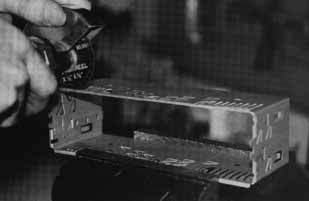
An extra stereo mounting frame was used to mount the Apex electronics, To fit the frame below the stereo, we had to cut the lip off the top of it. We used a air-powered cutting wheel, but if you don’t have one you’ll just have to get creative. The meat is relatively thin and easily cut.
Since the Eclipse didn’t have a CD changer, and we often end up driving the car long distances to events, we decided to go with Alpine’s 3DE-7886 three-disc in dash CD changer. it turned out to be a good choice. The amplified unit (35Wx4 channels) gave us good CD selection without eating up a bunch of cargo space with a changer (those long trips mean a lot of luggage in the Eclipse’s surprisingly large cargo space). And the unit was packed with enough features to keep even the most ardent gadget hound occupied for hours. Things like programmable preset address indicator, station title memory and automatic memory programming for the tuner, with 8X oversampling, a 1 bit DA converter, disc title memory and a host of other features we never, got to explore. We had Competition Soundworks in Cerritos Calif. install the CD Changer and a set of Alpine speakers in the doors.
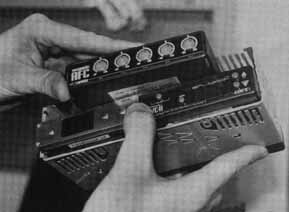
The Apex boxes were hot glued into the frame before being inserted into the dash.
We wanted to mount all three devices in the dash, big with the double-DIN sized factory stereo/CD/cassette deck taking. up all the room there was nowhere for them to go
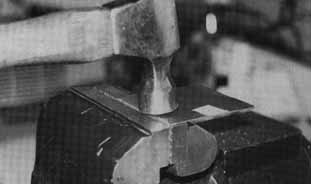
To fill the hole left next to the AFC, we bent up a sheet metal block off plate,
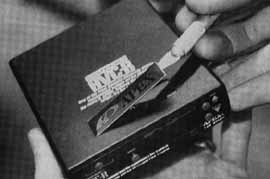
We then peeled the Apex plaque off the top of the turbo timer and mounted it on the block-off plate.
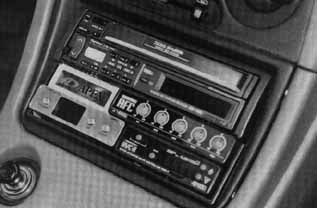
The new arrangement was definitely worth the work. The installation looks clean and well organized, and the Alpine stereo sounds great!
The CD changer was mounted in the top half of the double DIN hole to allow the CD cassette to shuffle without interfering with the shifter To mount the Apex electronics we used an extra mounting frame. Both the turbo timer and the AVC-R boost controller are quarter DIN sized, while the AFC is slightly wider. We could fit all three boxes in a single DIN slot with a small gap left next to the AFC. To mount each box, we simply used a hot glue gun to stick it to the frame, while the gap was filled with a sheet metal panel we cut out, and decorated with an Apex emblem we peeled off the top of the boost controller.
The Pace Setter shifter shortens shift throws by at shortening the rod above the pivot, and lengthening the rod below the pivot point,
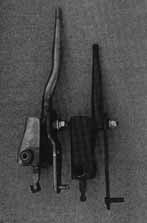
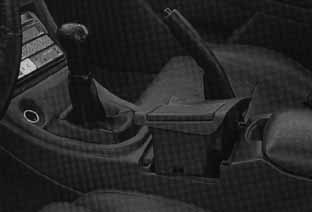
Accessing the shifter can be difficult if you don’t know where to start. The first step is to remove the ash tray, there are some hidden mounting screws for the center console under here.
On other interior notes, the Eclipse’s cable shifter is rather clunky and imprecise. It also has a relatively long throw that makes fast shifting a little difficult. In an effort to solve this problem we installed a short shifter from Pace Setter. The short shifter both lowers the shift knob and changes the lever ratio between your hand and the shifting cables. This both shortens the shift throw and increases shifting effort. The shorter throws are definitely an improvement, but the increased effort makes shifting even more difficult. The shifter didn’t really feel any more precise-,,, either, as the sloppiness appears to be a result of the cables and the internal design of the transmission more than the shift linkage itself. When we later, installed a RAZO shift knob that was a few inches taller, the shift effort improved dramatically. Since the knob effectively brought the top half of the shift linkage back to its original length, the lever ratio was somewhere between its original value and the ratio provided with the stock, knob. Another improvement to shift effort came when we installed our Exedy clutch. The three-puck clutch disc has less rotational inertia than a fully faced clutch disc. and since the syncros have to accelerate or decelerate the clutch disc whenever you shift, less inertia makes the syncros work faster.
We also changed to Motul synthetic transmission fluid at the same time, which also helped speed shifting (since we did the clutch and fluid at the same time, it is impossible to tell which made the bigger difference). Shift effort while driving is nearly the same as stock now, but first and reverse are still much more difficult.
[RRE Note: We were not happy with the performance of either the Pace Setter Short Shifter or the Exedy Clutch, we do not recommend either one.]
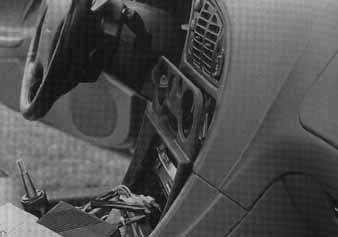
Next the trim panel over the ventilation controls must be popped off, Just get your fingers behind it and pull.
The RAZO shifter was originally installed for a show, as were a set of RAZO pedal pads. We were initially planning on removing them after the show, but when we discovered the improvement the shift knob made, we decided to leave it in place. Something similar happened with the pedal pads. Installing the pads not only makes the pedal surface larger and grippier, it also makes it closer to the driver, since the pads themselves are at least a quarter inch thick. Since most of the staffers driving the Eclipse on a regular basis are over six feet tall, nobody wanted the pedals any closer to them. The brake and clutch pedal pads came off almost immediately. The gas pedal pad, on the other hand, turned out to be very functional. The stock pedal is too small, too low, and too far from the brake pedal to be able to heel toe downshift. The pad moved the pedal just far enough to make the car much easier to drive. It my look a little funny, but having only the gas pedal pad in place worked perfect for our picky drivers
It may look a little funny, but having only the gas pedal pad in place worked perfect for our picky drivers
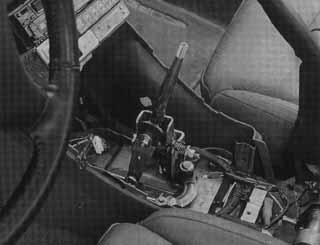
Once it is revealed, the shifter is fairly easy to replace
SCC Magazine – Project Eclipse – Part Five
by Dave Coleman
PHOTOGRAPHY: LES BIDRAWN, KEITH BUGLEWICZ, DAVE COLEMAN
A 28-Horsepower clutch? well sort of ….
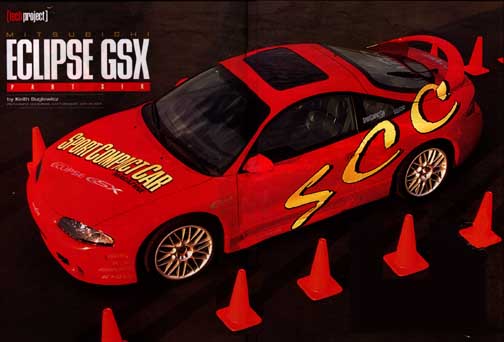
Project Eclipse has been the recipient of a very successful series of modifications. From the beginning, nearly everything we did to the car yielded very positive results. That all stopped with out last installment (September, 1998).
As you may recall, our last series of modifications began with a Hahn Racecraft (HRC 3-inch downpipe and high flow catalytic converter. That piece increased airflow so much that the fuel system maxed out the stock injectors just trying to keep up. This lead us to install larger, 550-cc/min injectors from RC Engineering and a larger fuel pump from Road/Race Engineering. The larger injectors required that we adjust the Apex Super AFC (the AFC adjusts the stock air mass sensor’s output so the computer can be fooled into delivering the shorter injector pulses needed for the larger injectors), Being short on time, we made our adjustments quickly and largely by the seat of our pants (and with the help of an Apex exhaust temperature gauge). The result was a car that sounded cool, sucked down a lot more gas, and made exactly the same power as it had before this series of changes. We were confident,, however, that the only reason the changes had not made power was the sloppiness of our tuning.
Shortly after we discovered the lack of improvement, we took the car back to Mike Welch at Road/Race for a more careful tuning session. Welch has tuned numerous Eclipses with the Super AFC and has the procedure pretty well nailed down. First, he plugs a laptop computer equipped with OBD Tool software into the diagnostic plug under the dash The OBD Tool software not only allows you to read the fault codes from the OBDII system, and to reset those fault codes (thereby turning off that annoying “check engine” light), but it also allows you to monitor and data log many of the stock ECU inputs or outputs.
There are five knobs on the Super AFC, each offsetting the air mass sensor’s output at a particular engine speed (the AFC creates a smooth line between these points to establish an overall offset curve). The first knob, which sets the 800-rpm point, is adjusted by simply letting the car idle while monitoring the 02 sensor voltage with the OBD Tool software. With the knob adjusted properly, the 02 sensor’s reading should constantly cycle up and down as the computer operates in its self adjusting closed loop mode. Given the fact that the RC Engineering injectors are 23 percent bigger than the stock injectors it is surprising that the first knob is turned down only a few percent to idle properly
For the next two knobs, covering the 2400 and 4000-rpm points, Welch adjusts them by logging 02 sensor voltage at full throttle in fourth gear. Using a lower gear would not load the engine enough, nor would it allow the engine to be in that rpm range long enough to easily see what is going on. Ideally, 02 sensor voltage should be about 0.94 volts as seen on the OBD II Tool. Under these conditions; ours was 0.98 volts when we brought it in-way too rich, according to Welch.
Finally, the last two knobs (5600 rpm and 7200 rpm) are adjusted by watching exhaust temperature at full throttle in fourth gear. It doesn’t take a rocket scientist to realize that watching the exhaust temperature gauge at the top of fourth gear requires either a closed race track or a trip to Montana with a notebook full of explanations for why 130 mph is reasonable and prudent. According to Welch, the exhaust temperature should be about 600 degrees C (about 1650 degrees F) at high rpm under maximum load. Before Welch made the adjustments, exhaust temperature never went over 800 degrees C, another sign that the engine was running too rich.
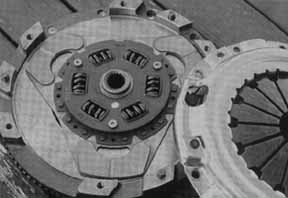
Our new Exedy clutch combines a three-puck cerametallic friction surface with a sprung clutch disc to provide incredible gripping power and heat resistance with reasonable driveability.
[RRE Note: we were not happy with the performance of the Exedy clutch and do not recommend it]
Even after tuning the AFC, Welch felt the car still wasn’t running right. No matter how he set the boost controller, boost pressure would always drop to about 15 psi by redline. With a stock turbo, this is to be expected, as it can not move enough air to make more boost at high-rpm. Welch’s experience with the Turbonetics-upgraded T28 turbo we were using, on the other hand, told him there should be more boost available. After investigating a few dead ends, the OBD Tool again offered the answer. By data logging speed and rpm during a hard fourth-gear pull, Welch noticed that instead of speed and rpm increasing in lock step as they should, the rpm line would start climbing away from the speed line. The only explanation was a slipping clutch.
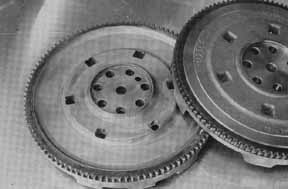
The Road/Race flywheel has four pounds of iron machined away, The majority of that weight was removed from the outer portion of the flywheel where the change can make the most difference. The stock flywheel on the right shows how much metal was removed.
A slipping clutch explains a lot about our experiences with the Eclipse. First, the loss of boost came from the loss of load. Spinning the clutch is easier than accelerating the car, and the lighter loading on the engine reduces the amount of boost it builds. A slipping clutch could also explain some of our inconsistent power measurements. From one installment to the next we have noticed some strange variations; in the power output of our all-wheel drive Eclipse as measured by our Vericom. Some of the variation could have been caused by differences in temperature affecting intercooler performance, or by the ECU switching to extra-conservative fuel and timing maps as weather conditions changed. Now we can add a slipping clutch to the list of things that could be changing power output at the wheels from run to run.
Given our Eclipse’s tremendous power, immense weight (over 3500 pounds with a driver) and all-wheel drive grip, a slipping clutch is no surprise. In fact, you might call it a design feature. In most cars, the clutch is designed to slip before driveline parts start to break- This is especially true of all-wheel drive Eclipses. With 210 horsepower and all wheel drive, there is a natural tendency for every common-sense-challenged yahoo who gets behind the wheel to try and spin all four tires. To save countless thousands of dollars in warrantee claims resulting when these same yahoos find out the transmission isn’t up to the task, the clutch in the GSX was designed with two safety features: An overall capacity a little on the low side, and a damper in the clutch’s hydraulic system that slows the clutch’s engagement when that yahoo makes his or her attempt. While the damper was not getting in our way (the clutch slipping problem only occurred at high boost, well after the clutch was fully engaged) the low capacity of the stock clutch was a problem.
With 210 horsepower and all wheel drive there is a natural tendency for every Common sense challenged Yahoo who gets behind the wheel to Try and spin all four tires

Now that we have learned that our stock clutch has been slipping for an indefinite period of time, we can’t be sure how accurate any of our previous runs were. Power output may have been lowered by the clutch on any of our previous runs. According to the now questionable readings of our Vericom, the new clutch, along with the downpipe and injectors, gave us a huge gain of 28 horsepower. Based on comparisons with rated flywheel horsepower versus Vericom horsepower on our Sentra SE-R (Technobabble, May ’98), we estimate the Eclipse’s flywheel output to be at least 294 horsepower.
Before installing a higher-capacity clutch, we made some 0 to 60 runs to get some objective idea of how much of a difference the new clutch was making. Launching a turbocharged all-wheel drive car is a challenge. While the tremendous grip can give you a serious advantage off the line, getting the car to leap off the line without either bogging before boost is built, or belching the transmission out the bottom of the car is a challenge. The fastest launches came by bringing the engine up to about 3000 rpm, and rapidly feeding out the clutch and feeding in the gas at the same time. Using this technique we were able to pull off one impressive 5.63-second run, followed by the distinctive stench of clutch flambé. The heat generated by that one launch was all the clutch could handle. After that one clutch-smoking run, we were never able to pull off another sub-six second pass.
Our new clutch would have to be significantly stronger, but since the Eclipse is still a street car driven almost every day, we needed it to provide good driveability without excessive pedal effort or chattering during engagement. Our decision to try a three-puck cerametallic
Exedy clutch may seem like a surprising choice oven our requirements. In most cases such a clutch would grab so suddenly and chatter so badly that it would be absolutely undriveable. Street clutches are typically designed with a sprang disc, meaning that the center of the clutch disc-where power is delivered to the transmission-is isolated from the outer edge of the disc-where the disc is clamped by the pressure plate by several springs. These springs smooth the clutch’s engagement. Most cerametallic clutches are designed with a solid disc simply because most sprung discs can’t handle the higher torque load. While it seems like the obvious solution is simply to build a stronger sprung disc, most performance clutch manufacturers make their clutches by modifying stock parts. Building a whole new disc would make the parts prohibitively expensive. Building performance clutches by modifying stock parts certainly works, but it does place some limitations on the design. Exedy, on the other hand, is a OE clutch manufacturer (Exedy actually owns Daiken Clutches), and they therefore have the facilities to be able to engineer and build clutches that most low volume manufacturers would not be able to. Hence their claim that their three-puck cerametallic clutch could be used on a street car.
The OBD Tool software Is used to monitor engine functions as tuning adjustments are made. The jagged line here is O2 sensor voltage cycling up and down as the computer self-adjusts fuel mixture at idle. The 800-rpm knob on the AFC must be set within the proper range to allow the computer to do this.
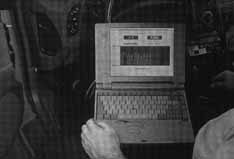
Here the OBD Tool is showing the data logged run that first revealed slipping clutch. The line on top is RPM, while the line on the bottom is speed. Both should increase together, but because of our slipping clutch, the rpm increased more than the speed.
That sounded like the perfect solution, so we decided to put their claim to the test. The Exedy clutch has a clamping force of 880 pounds compared to the stock clutch’s 700 pounds, but because the three-puck design concentrates that force into much smaller area (only three pucks instead of a full disc) the pressure on the friction surface is event higher. The result is an overall torque capacity 63 percent higher than the stock clutch.
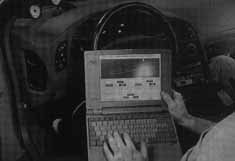
When Road/Race installed the clutch, they suggested installing a lightened flywheel as well. While the Road/Race flywheel is only 4 lbs lighter than the stock one (14 lbs vs. 18 lbs), most of that weight has been removed from the outer edge of the flywheel where it can make the most difference. Since rotational inertia goes up with the square of the distance (in other words, removing weight from the outer edge will make four times as much good as removing it from halfway out from the center) where you remove weight makes much more difference than how much you remove.
After installing the clutch and flywheel, Welch drove the car for a day to help us break it in. Initially, he reported, the clutch did chatter and grab rather severely, but as the clutch broke in, engagement smoothed considerably Only a few days of normal driving were required before the clutch began to behave in a civilized manner Pedal effort is quite high, even though spring force is only 25 percent higher than stock. The fact that the stock clutch’s effort is already quite high makes 25 percent a significant difference. The clutch is also slightly grabby as any clutch this strong has to be, but overall, if you can cope with the clutch on an early ’80s Porsche 911, you cope with this one.
Next came the tests. With the clutch broken in, we returned to our 0-to-60 mph test. Launching the car is not really any easier with the stronger clutch-engage it too suddenly and you can still bog it quite easily, but now excessive slippage will not overheat the friction material. Much like brake pads, an organic clutch facing material will tend to “float” when overheating causes resins in the facing to bum off. The cerametallic facing has no such problem-heat has very, little effect on our new clutch’s performance. Excessive slippage is still a bad idea, though, as the clutch will tend to grab and chatter if you launch at too high an rpm. Once we found the sweet spot, though, the all-wheel-drive Eclipse launched with such ferocity that it could actually chirp the front fires.
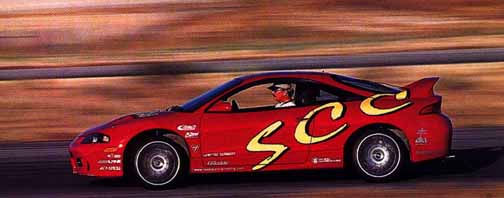
From the first 0 to 60 run it was clear that the new clutch was not slipping at all. Previous runs required either you either to shift to third gear or push the engine a few hundred rpm past the redline before reaching 60 mph. With the new clutch, redline took the car all the way to 68 mph-proof that the stock clutch was slipping at several hundred rpm even in second gear!
Our best 0 to 60 run was an impressive 5.54 seconds, an improvement of almost a tenth of a second. Even more significant was the fact that while the stock clutch could only handle one good run before overheating, the Exedy clutch withstood run after run, back to back, with out ever running longer than 6 seconds. in fact, our best run was on the third attempt.
Once we found the sweet spot, though, the all-wheel drive Eclipse launched with such ferocity that it could actually Chirp the front tires.
The final test was to do some second gear pulls with the Vericom to determine our power output. This would be our first chance to finally evaluate the performance of the HRC downpipe and catalytic converter and the 550cc/min RC Engineering injectors, as well as the Exedy clutch and Road/Race flywheel, and the fine tuning work performed by Road/Race. To our great relief, peak output was up 28 horsepower. This is especially impressive when you remember that we are still using the tiny stock intercooler. The peak power reading given by our Vericorn is 210 hp, but as we discovered in our dyno comparison test several months ago (Technobabble May, 1998), the Vericom’s readings are consistent and precise, but quite a bit lower than a Dynojet. Our test of a 140-hp Sentra SE-R registered only 100 hp on the Vericom (and 117 hp on several Dynojets). Since our Eclipse’s output is 2.1 times that high, we can confidently estimate flywheel output at a bare minimum of 294 hp.
In reality, the GSX’s all-wheel drive system has to have higher driveline drag than a front wheel drive SE-R, so real flywheel output must be well over 300 hp.
We have seen this phenomenon before, but it is always interesting to see it happen. The HRC downpipe and cat, and the RC Engineering injectors obviously did their job and did it well, but simply slapping them in place and hoping for them to work won’t cut it. An engine is an amazingly complicated system and whenever you mess with one variable, you invariably will affect another one. in our case the increased air and fuel flow had to be properly adjusted to create power, and then the clutch had to be strengthened to actually harness that power. People are constantly asking us how some combination of parts will work on their car. Results like this are the reason why our answer is almost always “it depends”.
SCC Magazine Project Eclipse – More boost!
Sport Compact Car Magazine, October 1998
by Keith Buglewicz
PHOTOGRAPHY: LES BIDRAWN, KEITH BUGLEVVICZ
We Continue or Quest for Elusive Extra Boost
Our Project Eclipse has come a long way since we first got the car back in May of last year. Our first upgrade was to the suspension and throttle response. The suspension improvements-four Eibach springs and four Koni adjustable struts-worked like a charm, calming the sometimes-wallowy ride of the Eclipse. To fill in the vast, vacant wheel wells, we added 18-inch Kosei Seneca wheels and Dunlop SP9000 tires. The engine upgrades consisted of a cat back exhaust, an intake and a better intercooler pipe, and worked surprisingly well to give the Eclipse a measured gain of 32 hp. Next, we added an Apex electronic boost controller and AFC fuel computer in a quest for more boost. They helped, but we were limited by, the inefficiencies in the stock turbo. We took care of that with a new turbo that had been thoroughly massaged by Turbonetics. The improvement was drastic.
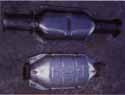
The differences in the stock catalyst and Random Technology catalyst supplied by HRC are dramatic. The overall shape is the same; however, the inlet and outlet pipes on the Random catalyst are monstrous compared to the Stock unit
But there was still more work to do. With the bigger turbo, the stock fuel injectors were at maximum capacity, often running at over 90 Percent duty cycle at higher revs (the Apex AVC-R boost controller can read injector pulse width). It was clear that if we wanted to run more boost, we needed more fuel. in addition, we wanted to complete our exhaust system modifications with a three-inch downpipe and catalyst from Hahn Racecraft (HRC).
The cliché says a chain is only a strong as its weakest link, and that was the case in our Eclipse’s exhaust system. The stock turbo outlet had been ported by Road/Race Engineering when the new turbo was installed (see “Project Eclipse”, March 1998). We wanted to find out how much of a difference installing a full three-inch exhaust system would make on the car, however. There were few problems on the intake side, with a free-flowing air filter, blockage-free intake pipe and a round (instead of kinked and flattened) intercooler-to-throttle body pipe. However, the engine couldn’t quite get the exhaust out properly because of the puny catalyst inlet and outlet, and the small pre-cat half of the exhaust system.
HRC offers an excellent selection of Eclipse performance parts, and their new 3-inch downpipe caught our eye; a beautifully crafted stainless steel piece with nice straight welds, a built-in flex joint and all fittings and fasteners needed to get the job done. The catalytic converter was from Random Technology and features a 3-inch inlet and outlet. This contrasted with the stock cat, which actually necked down a little from the stock 2.25-inch pipe, causing a major flow restriction. The idea behind the HRC system was it should be used to modify an existing 3-inch cat-back system. In other words, you have to cut off part of the existing performance exhaust system on your Eclipse and weld on a new flange to use the HRC system; something of an advanced procedure. Most cat-back exhaust systems for the Eclipse start out at 2.5-inches so this is the only way a 3inch downpipe and cat can be added. To do it properly, a good lift, saw and welding tools are needed. In other words, take it to a professional.
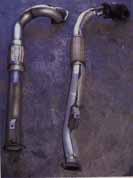
Note how the stock downpipe chokes down considerably after the cast iron collector. Keep in mind that the majority of the width shown by the stock system is heat shields the HRC piece is a true 3-in. pipe.
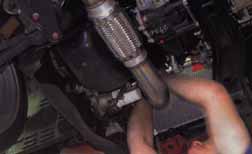
The easy part was getting the HRC pipe in part was reaching up into the tight confines of the engine compartment and bolting the pipe to the flange of the turbo.
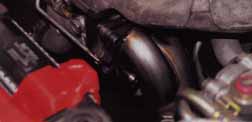
You can see why getting the pipe on was so difficult. Note there are two more bolts not visible here, HRC even tapered one bolt (under the waste gate pipe) to make getting it in a little easier, Regardless, it was a tight squeeze. With the pipe in place, changing the oil filter is also a little more difficult, but the pipe was carefully designed to give exactly enough room to get the filter out.
Attaching the new catalyst to the existing exhaust system was supposed to he straight The flange from the old system would he cut off, the new flange welded on, and the whole shebang would just belt right together It didn’t quite happen that way
Once again, we utilized the talents of the technicians at Road/Race Engineering in Huntington Beach, Calif., for the installation. Installation of the new pipe appeared to be straightforward … at first. The three-inch downpipe was a tight fit, and only after some serious grunting, groaning and a series of words unprintable here did we finally get the pipe in place. The fault didn’t lie with the downpipe itself; there just isn’t a lot of room to work in the Eclipse’s engine compartment. Installation necessitated removing all the heat shielding from around the turbo, and removing the radiator fan as well for extra clearance. The stock downpipe was extracted as one piece from the car, and was relatively simple to remove. The HRC piece, on the other hand, proved difficult. The stock cast iron collector South of the turbine is physically much smaller than the HRC piece, and does not incorporate the long external waste gate runner the HRC pipe does. As a result, getting the HRC pipe to fit required a little extra effort. HRC is aware of the tightness of the compartment, but aside from supplying a special tapered bolt to clear one of the tightest spots and some hints on getting their pipe in, there is little they can do.
The second part of the system proved to be more challenging than the first. We had to cut off a considerable length of pipe to get to the three-inch portion. This caused a cascade of problems. Note the dogleg bend in front of the resonator; this had to be custom fabricated later.
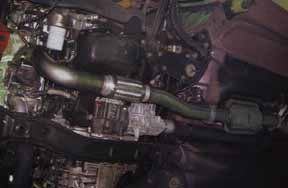
Mike Welch from Road/Race utilized a three-inch resonator to replace the one cut off in our exhaust system surgery. He also fabricated the necessary dogleg bend from spare three-inch pipe. To keep the OBDII system happy-Mike cut the oxygen sensor mount off the old exhaust and welded it onto the new one. The new system looked considerably beef ier than before. Note that although there were some tight clearances, nothing rubs against the bodywork, and the car only scrapes on very high center bumps that would give most lowered cars trouble,
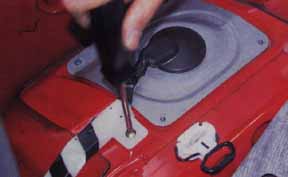
With the exhaust system in place, it-was time to replace the fuel pump and injectors. The pump was first. After the rear seat was removed, the access panel for the fuel pump was unscrewed and removed.
Attaching the new catalyst to the existing exhaust system was supposed to be straightforward. The flange from the old system would be cut off, the new flange welded on, and the whole shebang would just bolt right together. it didn’t quite happen that way. Everything seemed to be going smoothly until we realized the combined length of the HP( pipe and catalyst was too short. Once again this had little to do with the HRC ‘tern and more with the exhaust system we already had on the car The cat-back exhaust we used on the car didn’t flare out to its full 3-inch diameter until about 2 feet past the catalyst, which was where we made our cut. This extra length was too far for the HRC piece to span, eve with the long pipes on the ends of the Random Technology cat. So, we had to improvise. like any good tuner shop, Road/Race had lots of extra parts on hand. Among them was a sizable length of 3-inch steel tubing that was easily cannibalized for exhaust system duty. We also decided to add a 3-inch resonator to take the place of the one we had cut off the cat-back system (since the car is often driven long distances, a droning exhaust was the last thing we wanted). Mike Welch carefully measured the length needed and cut off the piece needed to make the system fit. Once again, we seemed to be on track until another problem reared its head.
Although the extra length of pipe and the new resonator were fine length-wise, they just weren’t lining up with the catalyst. The piece we had cut off incorporated a small dogleg bend. The bend compensated for difference of about a half inch in our modified system.
Since no amount of straining would bring the two together, Mike again came to the rescue by cleverly cutting the short length of pipe in front of the resonator. He was then able to line up the two pieces at last. Mike also cut a new hole for the stock post-cat oxygen sensor, keeping the OBDII system happy. Once the pieces were finally cut to fit, they were spot welded in place, and finally seam welded.
Despite the difficulties, the Frankenstein exhaust system looked terrific under the car. The extra welds and bends did nothing dynamically to restrict flow, and we now truly had a 3-inch “turbo-to-tip” exhaust system. The car now sports a deeper, richer exhaust note at idle that turns into a loud, angry blat at full throttle. We should point out that the exhaust does occasionally scrape, but only over high-centered clearances that would challenge almost any lowered vehicle.
The seat-of-the pants results were pretty good. Although the car didn’t need FAA certification, it certainly had better throttle response, along with better turbo spool up, which was mainly what we were looking for The differences in top-end power felt incremental at best, though, with no immediately noticeable difference at the high end of the tach. What was immediately apparent was that the system was flowing a lot more air.
How could we tell? A blast to redline on a cold day would cause the fuel cut to step in after the computer noticed the injectors hitting nearly 100 percent duty cycle. After a few of these incidents, the check engine light came on as well. Since this increased fuel and air flow didn’t seem to be accompanied by a substantial boost in high-end power, we theorized that the computer was over-fueling the car. To keep the engine safe from detonation, the computer was going dead rich, too rich to make any more power. The other hint that this could be the case was the blue faces of that followed the Eclipse in traffic raw gas smell was a little strong.
The official Mitsubishi tech manual prescribes a special tool to remove the large retaining collar that holds the fuel pump in place. Road/Race discovered another equally effective-if less elegant-way to do the same thing using much more common tools,
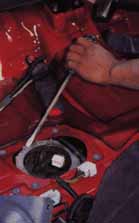
The electrical connection for the fuel pump was disconnected. In order to depressurize the fuel system, Road/Race turned on the car with the fuel pump disconnected. The car simply used up the fuel in the lines and died, They then disconnected the battery before proceeding. Even though the fuel system Was depressurized, there was still gasoline in the lines. If you are doing this procedure yourself, make sure You have something handy to catch the excess gasoline that spills out when the fuel lines are disconnected.
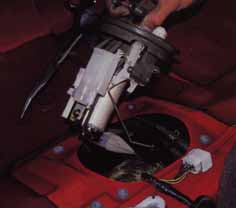
The fuel pump, float and sender all came out as one assembly. You may want to cover the open hole to the gas tank with something to prevent debris from falling in.
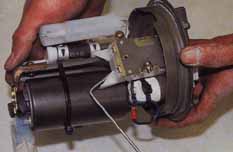
The replacement pump is physically much larger than the stock unit, and requires a lite modification of the various brackets to properly mount. Installation of the pump back into the tank is the reverse of removal.
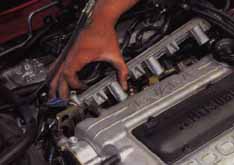
To replace the fuel injectors, all fuel lines to the fuel rail were disconnected, the injectors were unplugged and the rail was removed. If it can be removed with all four injectors attached, all the easier for the installer. Note the ‘A’shaped retainers above the plug for each injector. These need to be ground down to fit the new injectors.
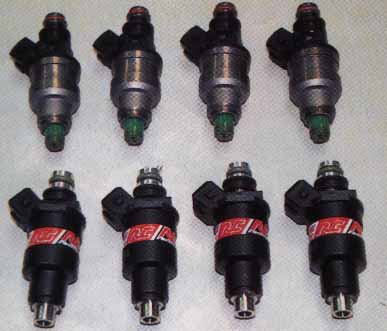
The RC’s injectors we chose flow 550 cc/min over the stock 450 cc/min (a 23 percent increase in capacity).
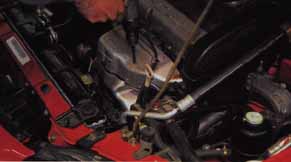
To monitor how much fuel we were giving the engine, we installed an exhaust gas temperature gauge from Apex The first step was drilling a hole for the temperature probe in the exhaust manifold. The hole should be as close as possible to the exhaust port without interfering with it. Mike actually drilled the hole in the manifold while the car was running, blowing any shavings back out the hole instead of allowing them to fall down into the turbo.
Carefully fiddling with the Apex AFC, we dialed the air flow meter input back four percent across the entire range (by simply turning each knob back four ticks). This dramatically improved power, throttle response, odor, and caused the check engine light to go back off. We were hesitant to tune any further, though, since we had no Exhaust Gas Temperature (EGT) gauge to see how our tuning was going (exhaust gas temperature is a good indicator of fuel mixture.)
Cold mornings still brought the injectors close to 100 percent, and we were eager to try more boost, so we made a call to RC Engineering in Torrance, California, for a set of new 550-cc injectors. RC Engineering is one of the best-known names in fuel injection technology. Its injectors are all flow matched so each injector in a set flows as close to the same as is possible. in an unusual twist, Russ Collins (the “RC” in “RC” Engineering) does not concentrate as much on fuel atomization as one would think. We all know what we think an injector spray should look like-a fine mist that sprays evenly from the tip of the injector. However, Russ showed us an injector equivalent to those provided for our Eclipse on his custom strobe-light-equipped spray observation station.
What we saw was surprising … no light mist, but a steady stream of fuel (well, test liquid, but you get the idea) that would shoot directly into the combustion chamber. Russ says that the atomization takes place in the turbulent environment of the combustion chamber, and that it isn’t necessary for the injector to do the job. The narrow stream is less likely to condense on the walls of the intake port, making the fuel mixture more consistent.
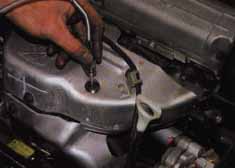
The probe simply screwed into position, with the lock nut keeping it in place.
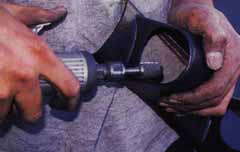
We mounted the EGT under the boost gauge in the Eclipse on the A-pillar. Road/Race supplied us with a double pillar mount to replace the single pillar mount. Like the first one, it had to be modified to fit the slightly oversized Apex gauges.
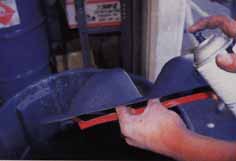
To give the piece a more stock appearance, Road/Race also painted it the factory gray of the rest of the interior.
The result was an ergonomic placement of the gauges right in line with the driver’s sight.
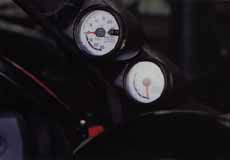
Installation of the fuel injectors was another reasonably straightforward procedure. Because it involved working with raw gasoline, it was a good idea to disconnect the battery to prevent any sparks. The entire fuel rail was removed, the new injectors were put in place, and the rail was popped on. Well, almost. Because the RC injectors have a slightly different connector location, the stock Mitsubishi rail had to be trimmed slightly. Simply a matter of grinding off some excess metal on the rail around the plug for each injector proved to be minor surgery.
With bigger injectors, the stock fuel pump would not be up to the job of providing adequate fuel pressure, so Road/Race also installed a larger Denso fuel pump.
The fuel pump was an in-tank unit, which meant removing the rear seat to get at the access hole on top of the tank. Once the pressure was relieved from the system and all hoses and connectors were removed, the large plastic ring holding the fuel pump in place was removed. The pump was removed as an assembly with the float for the fuel gauge. The pump itself was a metal cylinder about 4 in. long. The Denso replacement unit was substantially larger, and required a bit of modification to get onto the stock bracket.
With the larger injectors, the engine would automatically run way too rich, so we would have to use the AFC to dial in the fuel mixture. With this much fuel mixture fiddling, we absolutely needed an EGT gauge. So, we turned once again to Apex for an exhaust gas temperature gauge with a white face to match our boost gauge. Mike Welch of Road/Race showed us a good trick for installing the EGT probe in the exhaust manifold. To install the probe, you must drill and tap a hole in exhaust manifold. To prevent metal shavings from dropping into the manifold, and subsequently into the turbo, Mike drilled the hole while the engine was idling. This way, the exhaust blew the metal shavings out the hole and saved us a lot of worries.
As simple as this technique seems, Mike was quick to caution the inexperienced not to try it at home. it takes a great deal of finesse and practice to get the procedure down right one wrong move and a big piece of metal could fall into the turbo, with disastrous results. The safe way to do it is to remove the manifold altogether.
Once the hole for the sensor probe was drilled, it was relatively simple to route the lines to the gauge, which we mounted on the driver’s side A-pillar next to the boost gauge. mike tells us that the exhaust temperature should be 900 degrees Celsius at full throttle when everything is operating smoothly. Getting the temperature to that level involved tuning our gas flow with the Apex AFC fuel computer This procedure takes a while, and can be disastrous if done wrong. If in doubt leave it to professional tuners like those at Road/Race.
Initially we rough-tuned the car to run smoothly, and keep the exhaust conservatively cool. Tuned this way, the car made the same power it did before we did all this work. At the time we went to press, Road/Race was in the process of tuning it more precisely in the hopes of getting better power results. As we have observed before, the stock computer is getting very conservative about fuel and timing. Though you can tune this out somewhat with the AFC , you are only adjusting the air flow meter input to the computer, not adjusting the output. To really get things right, the ECU has to be re-programmed to remove the conservative fuel and timing maps. We plan to have this done, but in the mean time, we want to see exactly how well the engine can be tuned with the AFC. With the AFC tuned conservatively, the HRC downpipe and cat and the bigger injectors have only gained us responsiveness and status in the parts hanger’s club. The tuning step will be critical to making these mods worthwhile. The results of the tuning, however, will have to wait until the next installment.
Downtown LA Motors Street Race – September 5-7 1998
The PRO Racing Series features late model production based sports cars specially modified for racing. Competitors race in one of five class structures based on the performance potential of the cars. Makes and models in the series are Porsche, Ferrari, Acura NSX. Ford Mustang, Corvette, Dodge Viper, BMW, and more. Tops speed of the cars can reach over 175mph on the faster tracks. PRO Racing Series accepts only established race drivers. There is no room for the novice here.
Qualifying sprints on Saturday. On Sunday the PRO Racing Series will see its diverse field of sports cars engage in a one-hour “mini” enduro. As a result of mandatory fuel stops for all drivers, pit action and lead changes will abound. You’ll never know who will win till the checkered flag drops and the Ford L.A. Street Race double s-turns on the way to the finish line.
The PRO Racing series includes race events in such diverse places as Tijuana Mexico, Las Vegas, Laguna Seca, Willow Springs, and of course, the LA Street Race.

We had the opportunity to race with PRO Racing Group on a road course laid out around the Sports Arena in Exposition Park. Our 1992 GST is classified in the P4 class. The 1.1 mile course runs through part of the parking lot and out onto Figueroa St. The main event for the weekend was a 125-mile NASCAR Featherlite Southwest Tour race
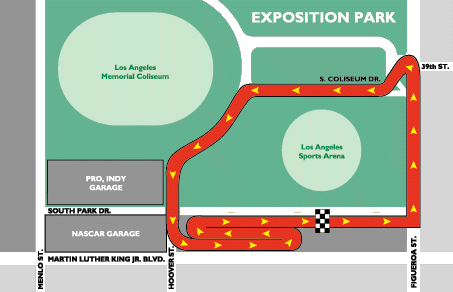
This was Rob’s first race in the RRE GST. Saturday we had a lot of problems with overheating the brakes. We are running the AWD dual piston calipers. We had run the car mostly at Willow Springs on the big track and braking had never been an issue there. Our Porterfield R4 compound pads stopped well enough but they are crumbling from the excessive heat. The course is made up of short straights and sharp turns. There is nowhere for the brakes to cool off.
On race day they did a cool Le Mans style start. As you can imagine it was pretty much pandemonium. The drivers all have their cars lined backed up to the edge of the track at a 45 degree angle. Motor off. When the green flag drops you start the motor and get going as fast as you can. I dont know why it takes big burly Porsches so long to get up and going but Rob fired up and jumped out in front of a bunch of them. They eventually got back by but the photo of him leading all those cars on the first lap was priceless!
Sunday the race was nothing but disaster. Since the PRO Racing group we run with are second fiddle to the Nascar race, we just get the mushroom treatment. Out practice times get cut to start with. Then the NASCAR race turns into a demolition derby on the short tight course. It is pretty much run under a constant yellow flag. It runs late and we are starting our race almost in the dark.
We changed out the calipers and pads overnight, added some better fluid and rigged up some ducting. Sunday they change the start to where you have the motor already running. Green flag and go. Then they decide to call the race short since their fire permit times out. Some of the drivers are pitting, some are still out and they just call the race. We have no idea how we did,
The mandatory pit stop really did us in. We came to a stop in the pits and the calipers burst into flames. The seals pretty much melted right out and the fluid caught fire on the red hot rotors. There just wasn’t enough track to do any kind of cool down lap and stay competitive with the brake setup we had.
We learned a ton from this race. It was a totally different experience racing in front of real people instead of rabbits and coyotes in the desert.
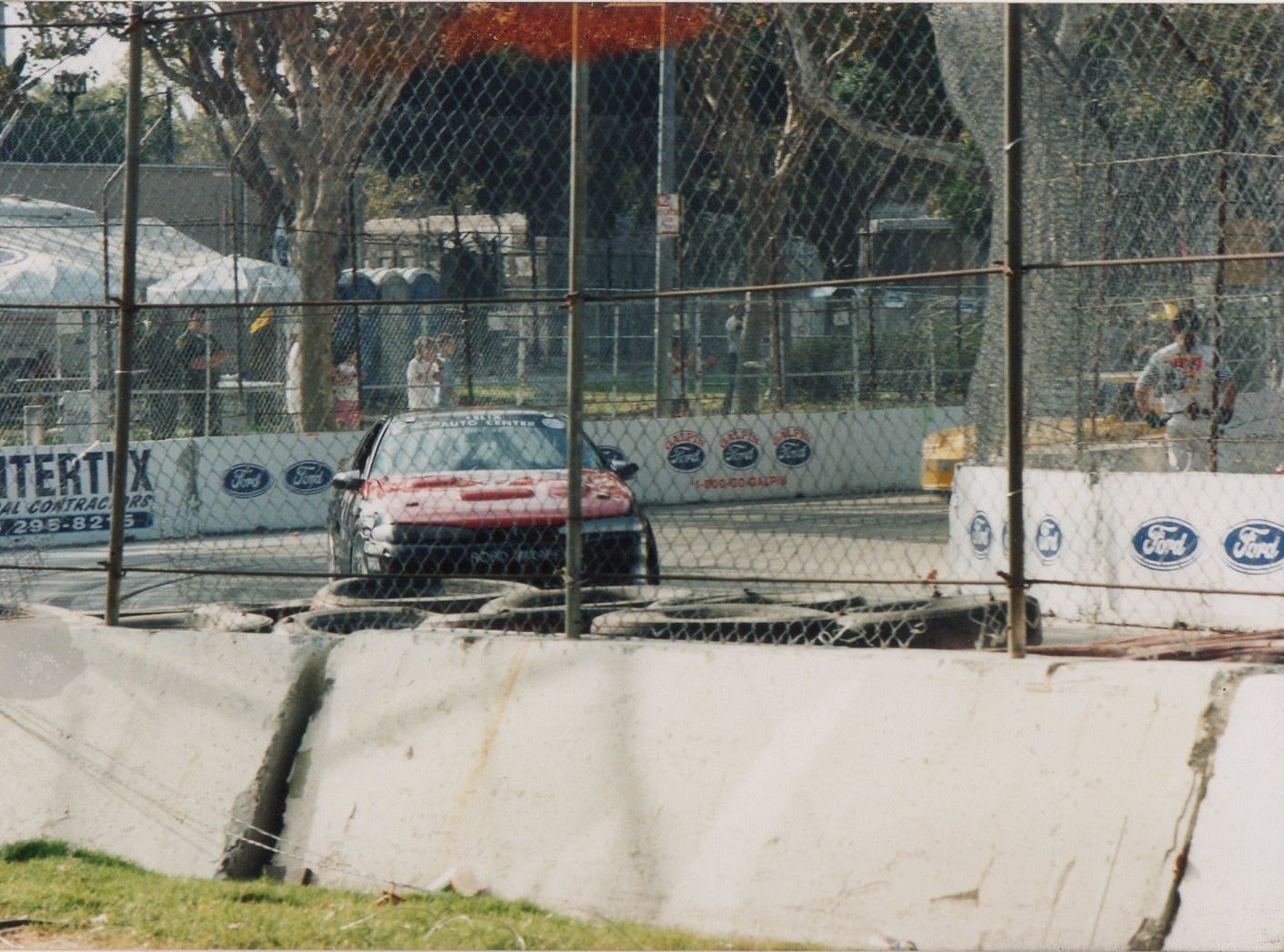
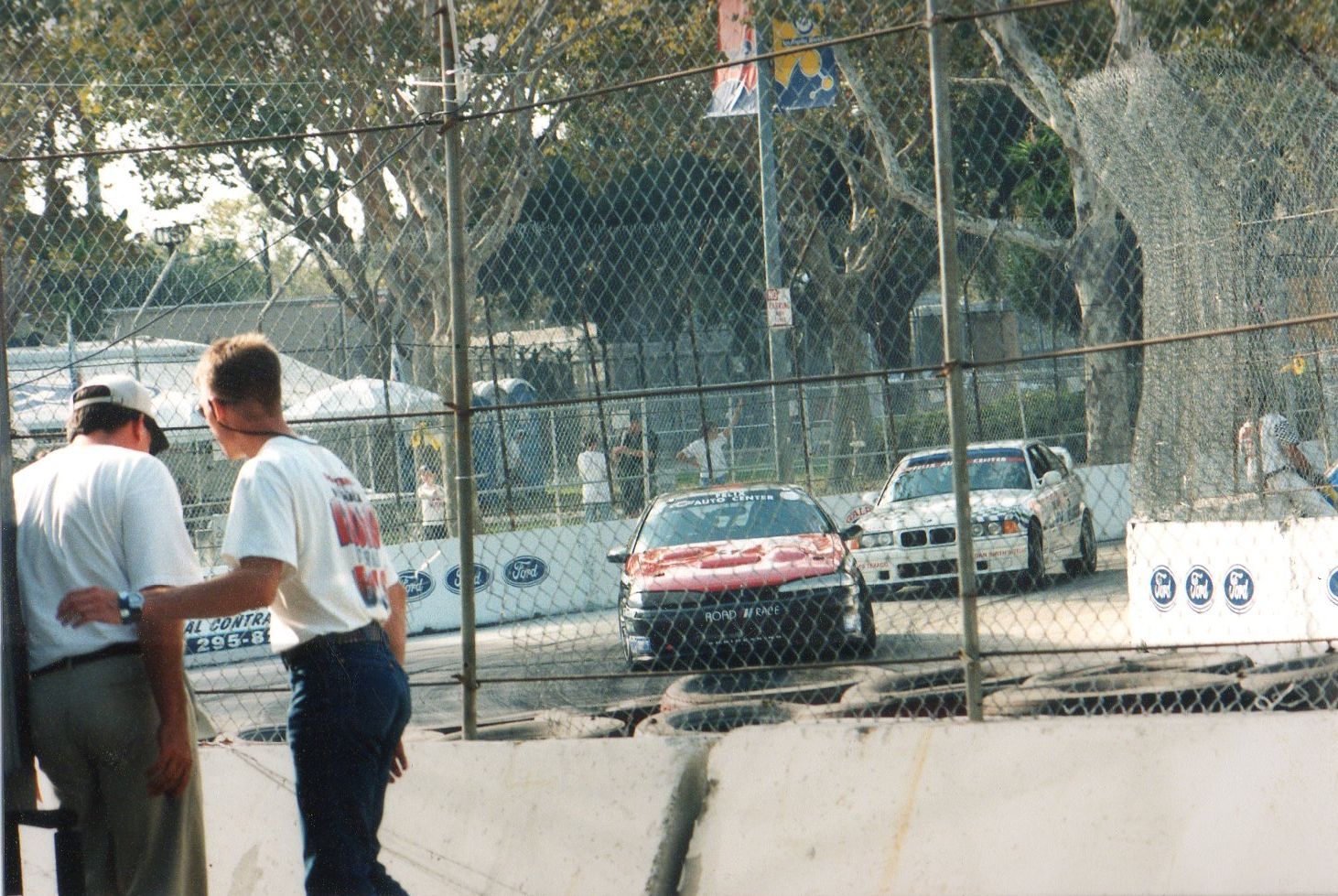
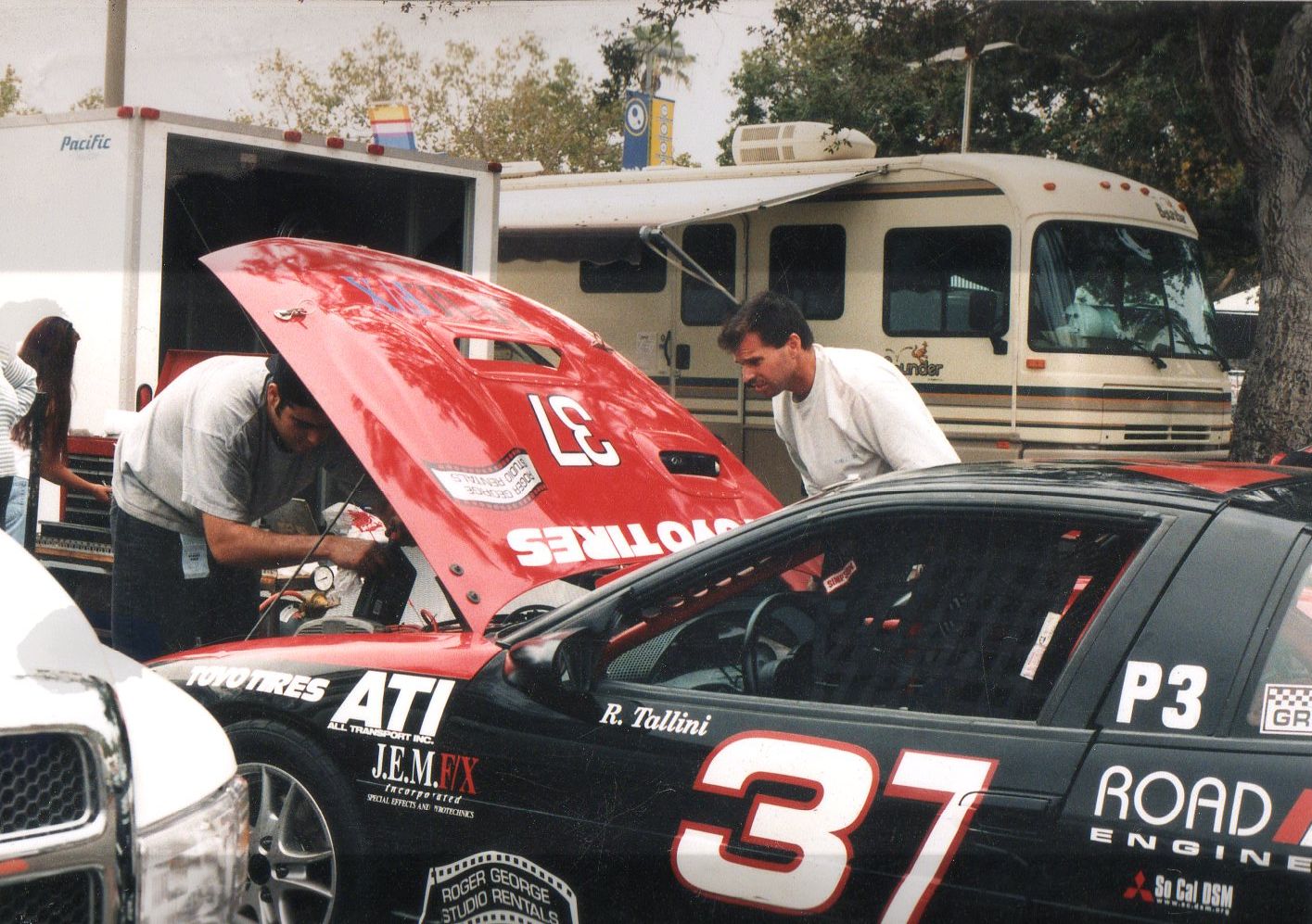
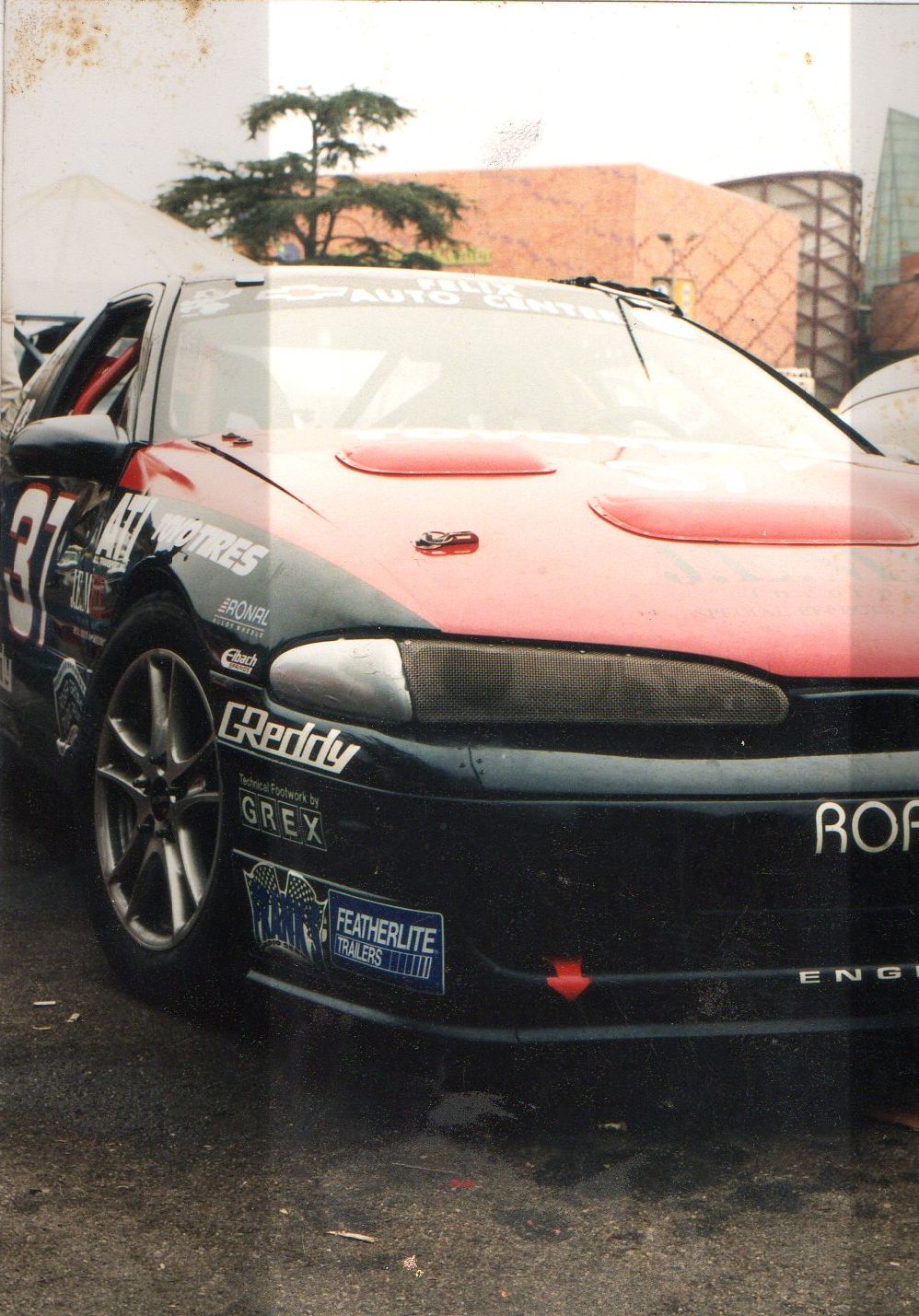
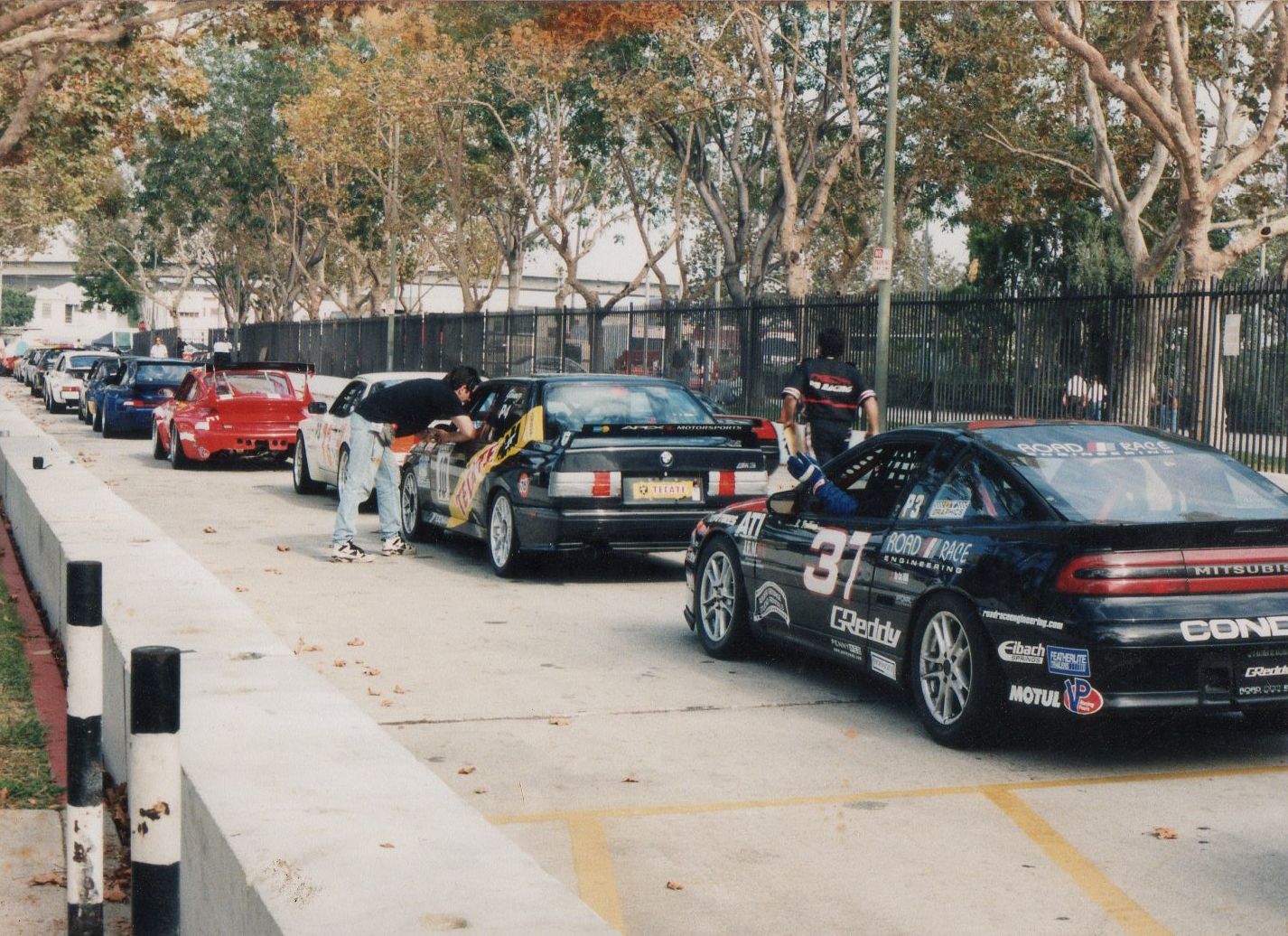

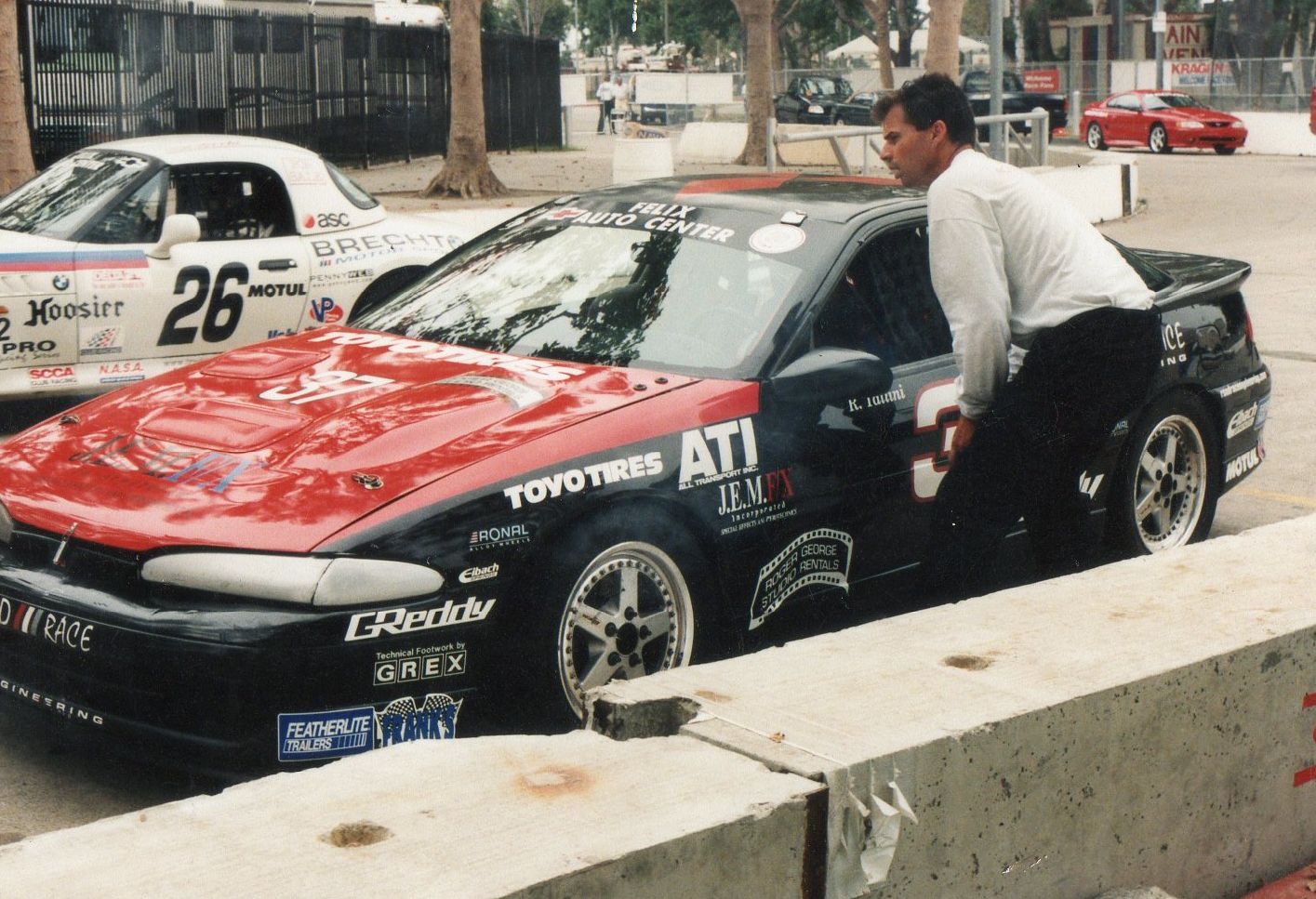
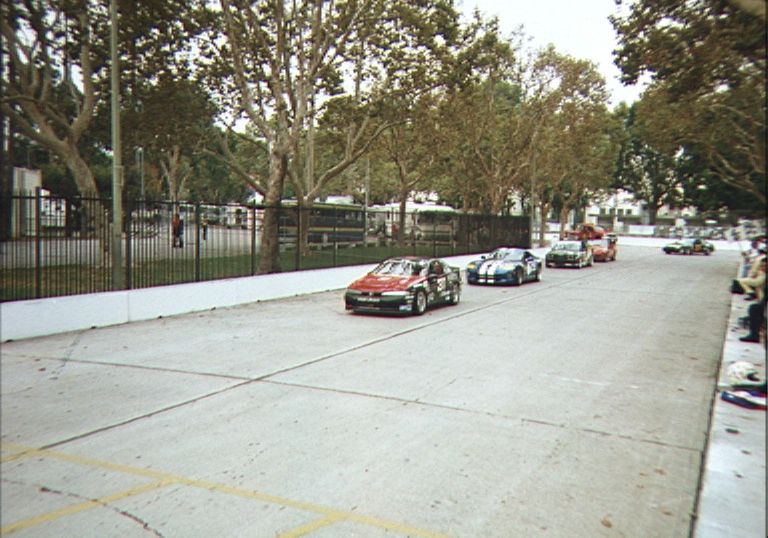
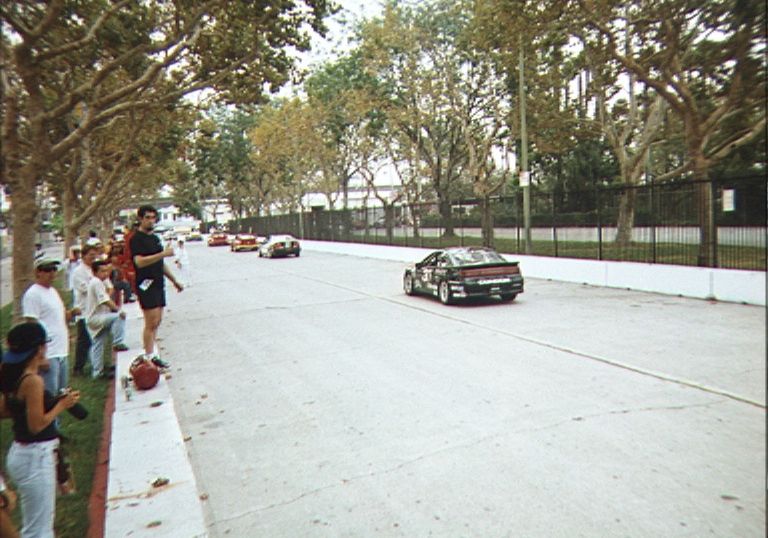
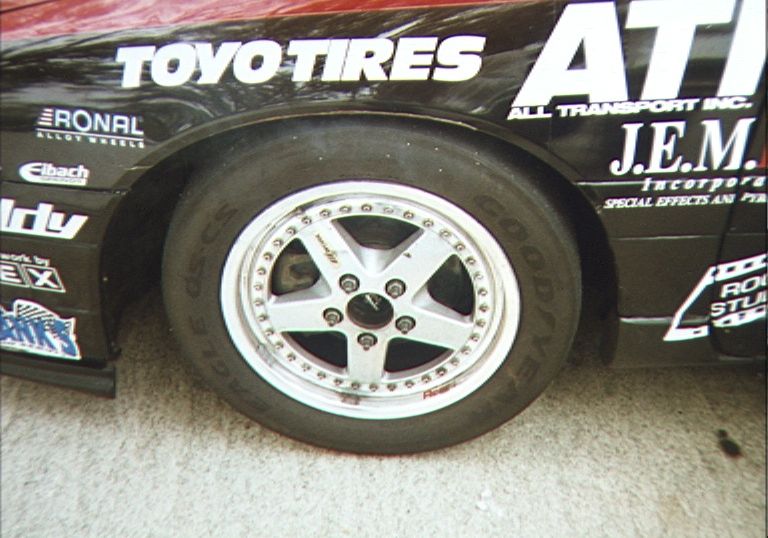
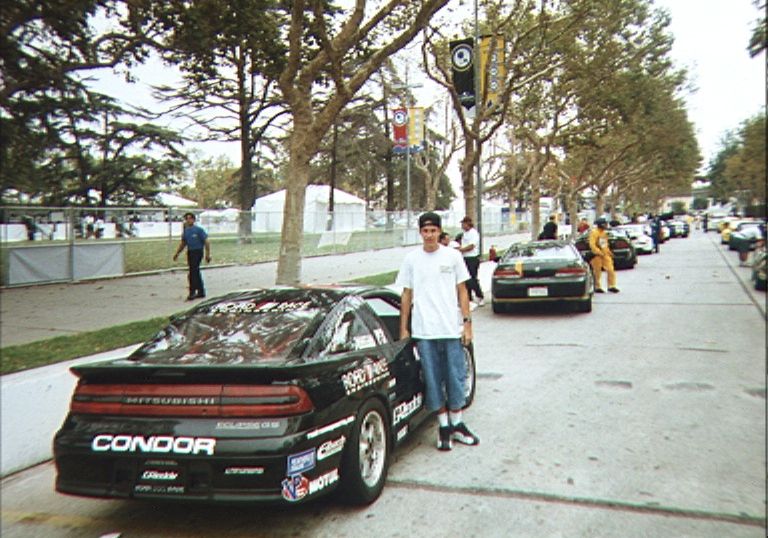
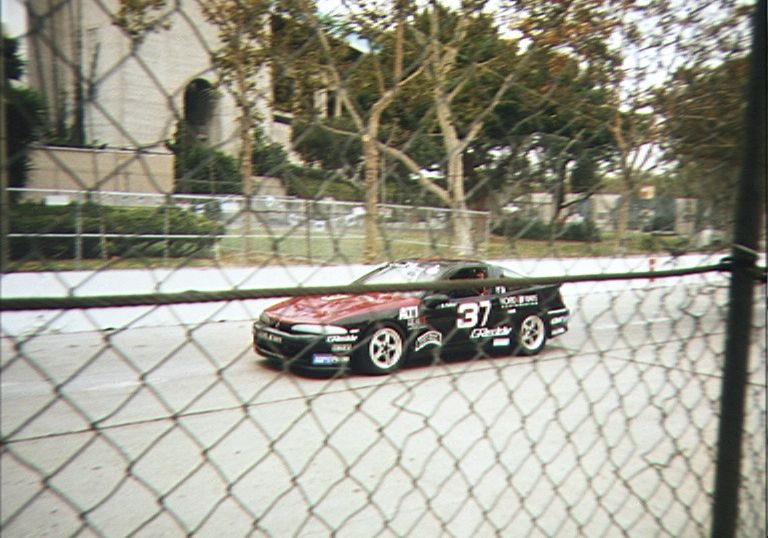

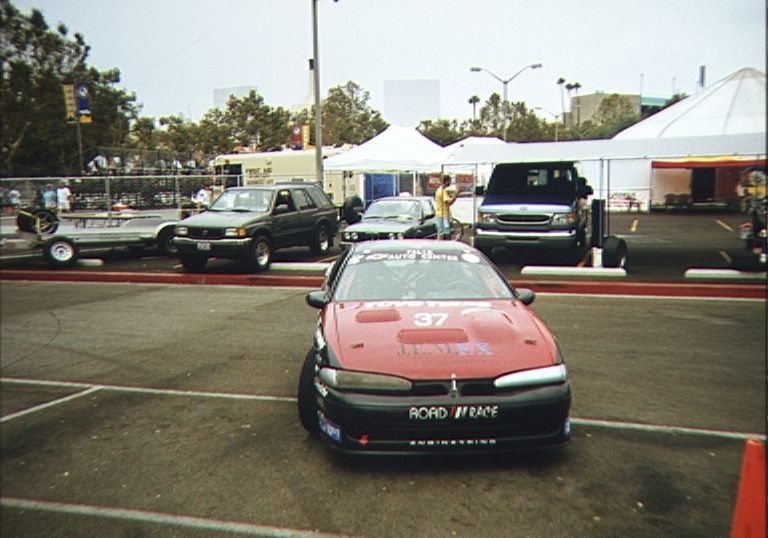
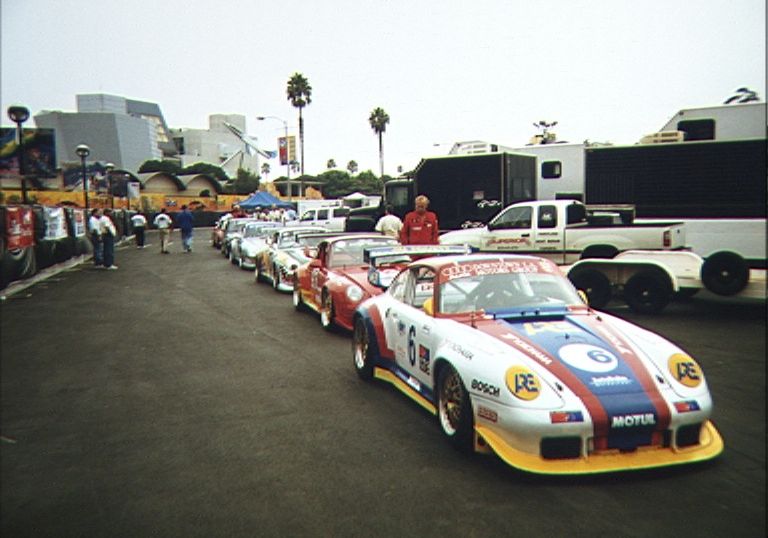
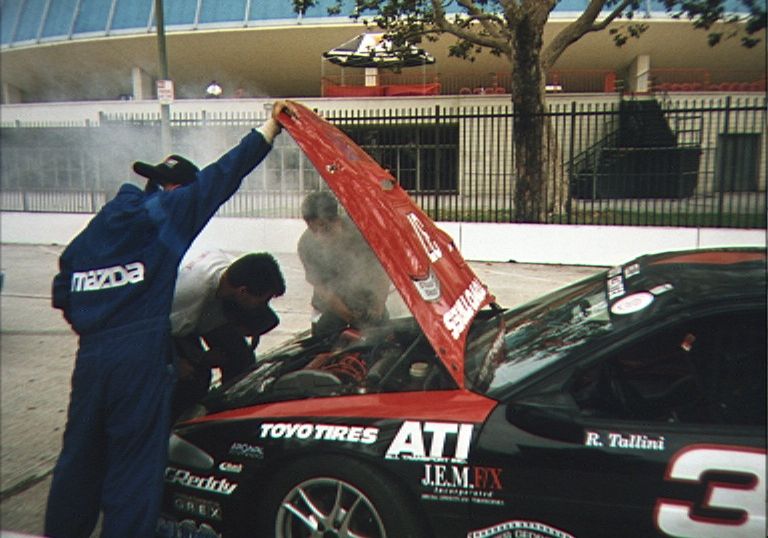

RRE 323 GTX Bosch BOV Instructions
This is a photo of the stock 323 GTX Compressor Bypass Valve or “Blow Off Valve” (BOV)
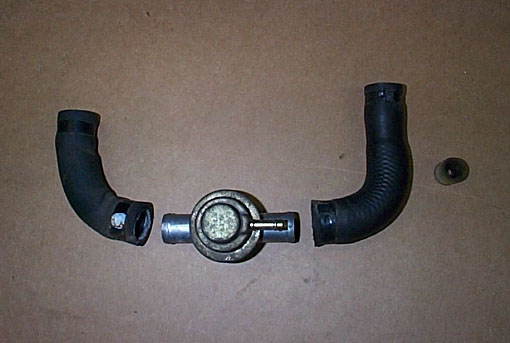
Inside the hose that runs from the pipe at the throttle body and down to the BOV, there is a restrictor that blocks the hose from 13mm down to 8mm. All your BOV air passes through this little hole. You can remove it to get some more flow through your stock BOV but with an open air filter you will hear some wicked bovine farty noises.
To remove the restrictor, find it by squeezing the hose to locate it. Pull it out with needle nose pliers.
An upgrade for a leaking BOV or to get rid of the strange noises is to replace the stock BOV with a Bosch BOV that comes stock on many European turbo cars. It is a quality part but can be had reasonably cheap. Expect to pay about $50, we keep them in stock. To connect it you will need two radiator hoses from an auto parts store. We used part numbers 71423 and 71409 from Pep Boys. I believe these are generic hose part numbers, possibly Gates numbers. If you cant get the numbers matched up, do like we did and ask for permission to climb the counter and go digging through the bins till you find what you need.
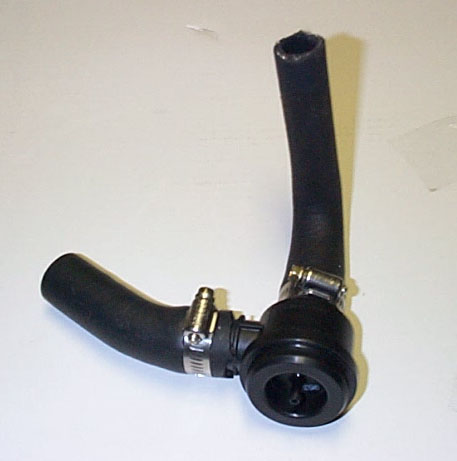
You need access to some slightly larger hose clamps, with the larger hoses and BOV, some of the stock clamps are not quite big enough.
This is a photo of the Bosch BOV installed. It uses a slightly smaller vacuum hose fitting, we used a small adapter to go from 6mm hose down to 4mm. The car this was installed on is still running stock boost. This mod eliminated the Moo Cow noises but did not make any noises that would frighten a honda or impress the ladies.
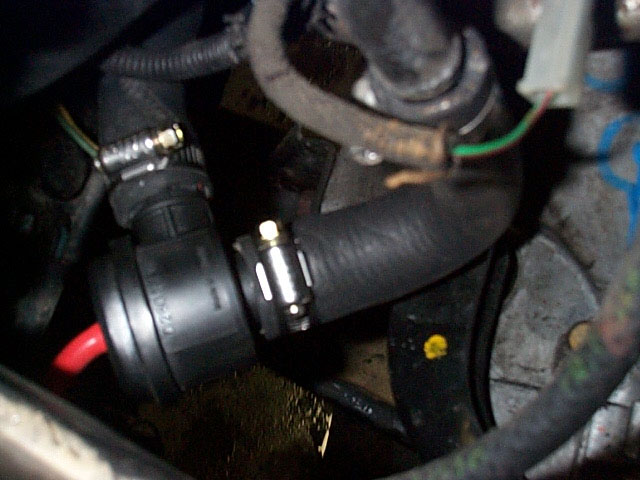
For more noise (good sounding noises… WHOOpshhhhh!) you can use a GReddy Type S BOV. It is a much more custom install best done with new I/C piping. The GReddy valve uses a two bolt flange that will need to be welded onto a pipe. The GReddy valves run about $200
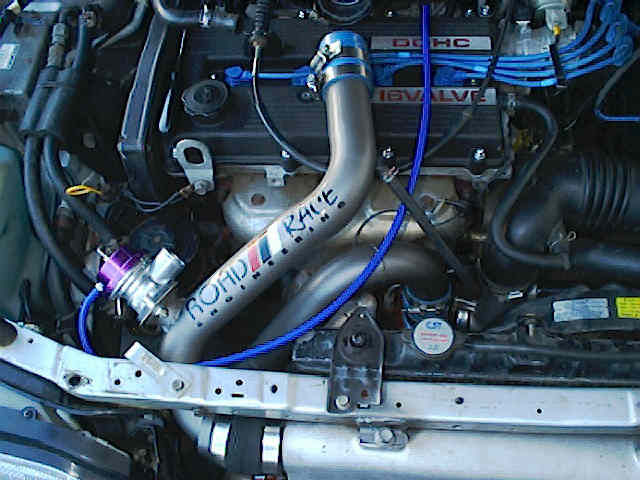
The GReddy BOVs shown here are blowing to the atmosphere. With careful adjustment you can get away with this to some degree. The lower pic to the right is on a car with a TEC2 ECU that allows you to blow the air out with no problems.
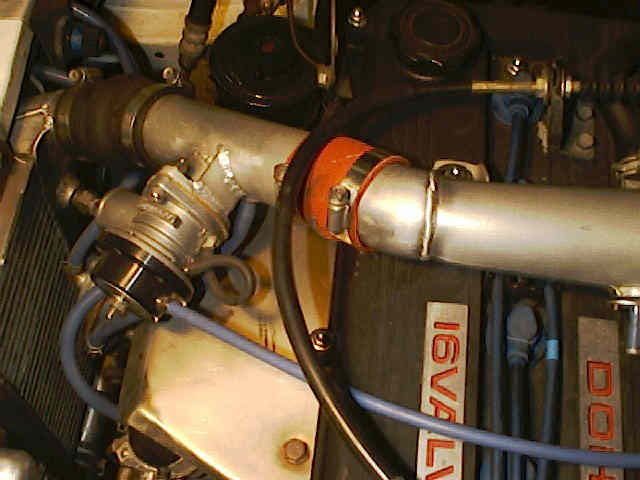
Marc S – Carlsbad in July – 12.14, clutch-limited..
I’m exhausted as hell so this will be shorter than my usual novels (but
still long) :)
– Billy ran an 11.97 I believe. YES! Finally an 11, now him & I can go
home & rest for the next few weeks, we are sick of going to the track
trying to get that 11 we both knew we could run :). Major congrats!
– I got a personal best of 12.14 @ 113mph. I continued to have major
problems launching… 60-foot times were mostly 1.8’s and 1.9’s. Highest
MPH for me was 113.6 mph. Other runs included: 12.15 @113.4, 12.18 @113,
12.18 @113 (another), 12.18 @112, 12.24 @113.2. I’m confident the car
could run 11’s… All it needs is a good launch… And/or remove the
headlight… And/or take off some weight like Billy :) hehe… Or add the
ITC… Or… :) But the bottom line is now that 11’s have been done I’m
taking a rest from racing for a month or longer & when I come back likely
it’ll be with additional stuff so I don’t have to just “squeak” an 11… And
I’ve got to figure something out about this whole clutch/launching
situation… Maybe re-treads for traction… Who knows. 4 puck clutches just
don’t seem to be the way to go for launching…
– Carlsbad… Anyone who went to Pomona missed out. Anyone who did not go
racing PERIOD missed out. There were 40 cars total at Carlsbad. I got
*16* runs in when I finally “had my fill”… Coulda kept going and probably
had 20+ runs! That’s 16 runs in about 2.5 hours time (2pm to 4:30pm).
Pretty insane! There were never more than 4-8 cars in front of you in
line! Weather was warm but the air wasn’t too hot unlike Pomona last week.
– DSM’s @ Carlsbad… Well, we just had our “West Coast Shootout” :).
Nearly 1 out of every 4 cars there was a DSM! We had about 9 cars (one
DSM wasn’t a Club DSM’er). With 4 of us running 12’s and 3 of us running
really low 12’s (and an 11!) we dominated and kicked muscle-car a$$. The
good ol’ boys were commenting how we were mopping up. I really enjoyed
killing some of the big loud big block slick wearing and super-charger
breathin’ brutes :)… We popped a lot of ego’s today :)
– We had an awesome drive after leaving the track with 7 DSM’s… The road
was 3 lanes wide, so we had 2 rows of 3 DSM’s (With Steve H. in the rear
trying to snap a picture)… Felt like I was in a fighter plane formation :)
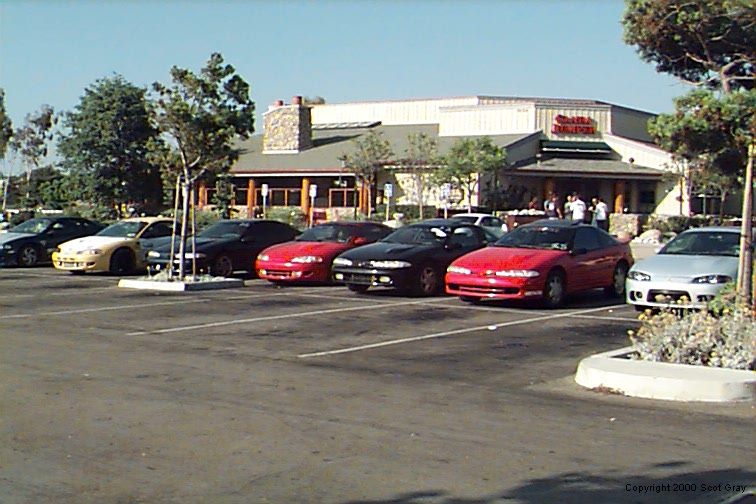
– Personal thanks go out to Scot Gray & Henry S. Scot let me borrow his
BFG TA R1’s to try to get more traction (couldn’t get them heated up enough
w/ drag racing so they weren’t as grippy as we were hoping) and Scot and
Henry were both a killer pit crew changing the tires back & forth :).
– On a final note… Damn DSM’s are built tough :)… In the past week I
have put *27* 12 second passes on this car, mostly low 12’s, without a
glitch (knock on wood). Mike Ferrara wouldn’t like it! :)
Hope you all had a good 4th.
-Marc
Marc S – Pomona in June – Awful new clutch, but 12.16 / 114mph
The good:
– The Pomona guys said it was the smallest turnout all year. We averaged
a run per hour for the first few hours, and then around 2:40pm it started
to become “run as often as you want”… You just ran & got back in line
again (with between 16 – 40 other cars!) So we ended up paying under a
dollar per run if ya don’t count the race gas :)
– Scott Terrace ran some awesome times, especially with his very short
list of mods… 13.3’s! This is right up there with those ol’ East Coast
stories of putting under $1000 into a DSM & being at low 13’s… Scott is
going for 12’s soon on the ultimate budget car!
– Bryan actually showed this time (hehe) and broke 13’s on his 14B car!
Yeeha!
– Had a first-timer come (I just know I’m gonna spell this wrong…
“Shino?”) and do awesome! Shino has a 2G FWD with limited mods and by his
3rd launch he had pulled a 2.3 60-foot time! He later pulled at least 2
2.2 60-foot times! (1/4 mi time was 14.6 I believe). Fantastic times for
a FWD & a first time at the track. Congrats!
– I had a new personal best & my MPH increased substantially.
The bad:
– Most of my times! Yeah, I know these times are faster than most, but
honestly the car has more in it so considering I started the day at a 12.19
@ 114.3 w/ a 1.857 60 foot time, the day was very disappointing for me.
The ugly:
– My 60-foot times were horrid. I could not launch the car worth a damn
with the new clutch. I wanted to rip that thing out and torch it. Even
with *11* runs (towards the end I was trying ANYTHING to see if I could
figure out a method to launch) I couldn’t do jack on my launches… Here are
some of the timeslips, then I’ll mention the “why”…
12.16 @ 114.5, 1.807 60-foot time
12.19 @ 114.3, 1.857 60-foot time
12.19 @ 114, 1.763 60-foot time (hit rev limiter bad on 1-2 shift)
12.32 @ 113.5, 1.897 60-foot time
12.32 @ 113.2, 1.922 60-foot time
12.34 @ 114, 1.895 60-foot time
12.40 @ 114.4, 1.972 60-foot time
Other 60 foot times included: 2.071, 1.971, 2.036, 2.254.
The day started off exciting… We knew on the first run that the engine was
11-second capable. Had the MPH, just needed a good launch… If I coulda
had a 1.71 60 foot time on that 12.19/1.857 run, the 12.32/1.922 run,
etc… Coulda grabbed an 11.9x. We all knew it and as the day went on I
was really really frustrated at not being able to improve the launch.
Here’s what was happening in-car:
I’d take the engine to various rpm, usually no less than 4500, and then
when it was time to launch I’d start stepping on the gas and then start
releasing the clutch. No matter how fast or slow I seemed to release the
clutch pedal, within the first few feet of launching, suddenly I’d hear
loud bangin’ noises coming from all 4 tires. The car ran *perfectly*
straight off the line and down the track, was not squirmy in any way. So
what did I figure? I thought I had wheel hop… That the tires were right
on the border of hooking up/not hooking up and were going back and forth
between the two, hence the physical banging I was feeling/hearing. (Every
launch now activated my windshield washers, too, so it seemed like I was
getting decent traction).
So stupid me, I spent almost all my runs trying to get the wheels spinning
a little more… I raised the RPM level of my launches, tried slipping the
clutch even more (it doesn’t like to slip at all), etc. I didn’t want to
be on the edge of traction… I wanted to have my wheels spinning more
cleanly for a little off the line, and then have them hook up solid… This
is how I got my low 1.7’s before, because the car still accelerates strong
with the spinning, and you don’t bog your engine. Most of the runs
Saturday I’d hit the rev limiter on the 1-2 shift too… Suddenly it would
jump to 7200 on my tach (my tach reads 300 rpm low) and there would be no
time to shift to 2nd before the limiter hit…
Realization of what was happening didn’t come until the 9th friggin run…
(I was kinda out of it the whole day from getting 3 hours max of sleep). I
can’t remember exactly how it happened but I mentioned to someone how I hit
my rev limiter at the 1-2 shift at my last run, and they responded “yeah,
you were in that rev limiter for a while”… (And I was thinking “that’s
odd, when rev limiter hits before I can shift, it’s usually pretty quick).
The spectator describes how my engine sounds *off the line* before I even
got to shift… Brah-brah-brah-brah (stutter stutter stutter). Ronnie comes
by & he confirms the prob… I was riding the rev-limiter throughout the
launch! It was impossible to hear the rev-limiter with helmet on, windows
closed, and big loud sounds coming from all 4 tires… Yeah, you could call
it wheel hop, but not because I was on the verge of traction… It was
because the engine was making so much power it was just annihilating all 4
tires and instantly going to rev limiter the whole way through 1st… As the
rev limiter hit, the wheels would go back & forth between gaining a touch
of traction & losing it again. The wheels were all spinning so evenly that
the car never felt squirmy in any way and simply stayed straight…
So yeah, I was running low 12’s with riding the rev limiter throughout
first gear. Engine made lots of power, clutch grabbed hard, tires couldn’t
hack it in any way. Plain & simple. Nice to know the why, but there
wasn’t anything I could do to go faster… Just couldn’t get any traction
with such a harsh clutch. The clutch did its job of holding the power. It
just did it too well! End of story.
I am gonna see about getting my rev limiter raised to 8000, perhaps that
will help a little… Now I know how a FWD’er with a built engine and no
slicks feels. I honestly think though that if I had my “old” clutch in the
car (before it blew a spring), 11’s coulda been mine :). Time to invest in
some tires.
Which leads us to today (Sunday)-
Billy- Kick some butt and bring us that 11-sec time slip we’ve been waiting
for… Our cars are definitely good for it. As long as you didn’t get my
type of clutch installed last night you will do just fine :)-. Good luck
to Josh too!
Marc S – Carlsbad in June – 12.20, but bye-bye clutch
Lots of mixed Carlsbad news… This will be lengthy.
Twas a very hot day which sucked for getting good times… On the positive
side it wasn’t too crowded, I got 5 runs in between 2pm and 4:15pm before
my car called it quits :(.
Run 1. First run had me really, really worried. 12.75 @ 105, w/ a 1.77 60
foot time. The car was hot & one or two of my shifts wasn’t quite as fast
as usual but that time was really off!… Checked peak EGT… 810 degrees…
Ok, running too rich. Leaned things out a couple notches.
Run 2. 12.34 @ 110. Phew, getting better, new personal best. 1.71 60
foot time. MPH still has me worried though. Was already getting 110 at
Pomona, before the cams, and the cams definitely have the car pulling
harder. Checked EGT’s… Still low. Leaned things out a touch more.
Run 3. Off to a decent start. 1.75 60 foot time, 7.89 ET in the 1.8th,
and 1/8 mph is almost 1 MPH higher than Run 2… Go to shift from 3rd to
4th… I don’t think I had my clutch pedal in all the way in time as I jam
it to 4th… But the *shifter* goes into 4th anyways but feels like it has
no weight when it gets there. Step on the gas but I’m not in gear, the
engine just revs. No 4th gear. For that matter, no any gear, the shifter
moves into all the gears with almost no resistance & I’m “in neutral”.
$h!t. Now I’ve done it! I coast through the 1/4mi – 12.98 @ 85mph!
What a run that woulda been if I had 4th gear :) My MPH in the 1/4 was
less than my MPH in the 1/8 and it was still a 12 :). I come to a stop at
the entrance to the return road (end of the strip), put on the hazards, but
the lazy Carlsbad officials just stare at me… So I think about it as I
move the shifter around… Ok, no resistance at all, & always in neutral…
Almost as if… The shifter ain’t attached to the cable no more! I yank
the plastic panel off under the shifter & look down there… Yep! The
cable came off. (It lost the cotter pin). I put it back on, get it in
gear & am on my way. Later I rigged a new pin by bending a key ring…
Problem solved.
Run 3 gives me time to think… Why are my EGT’s still so low, and what’s up
with the MPH (1/4 MPH for Run 3 was unusable but 1/8mph showed very minor
gains)… Then it dawns on me… My boost is low. Never raised it on the
way to Carlsbad. I had set it late the night before when the air was very
cold. I was probably running 18-19psi in the heat!… Up the boost a
touch… Time for run 4…
Run 4. Got a decent launch, but had a bog problem which to be honest
plagued me on all the runs… I’d get off the line quick w/ spinning tires
but would then hook up early, have a quick bog, and then take off. This
likely affected all my times that day. Gotta do some tuning, the cams
changed a lot of things. 1.73 60 foot time. 1/8th: 7.78 @ 88.35. 1/4
mi: *12.20* @ 109! I’m excited about the ET but still puzzled about the
MPH. For comparison, I ran 86-88mph in the 1/8th at Pomona in my 12.4 –
12.5 runs & always 110mph in the 1/4. I up the boost a little more (it was
probably still a little low, 19-20) & lean things out a little more in
preparation for Run 5. Looks like I will get several more runs in so I
have time to tune in small increments.
Run 5… Disaster strikes. The run was bad from the very start. For the
first time, my less-than-happy-to-disengage-when-hot clutch has a very
noticeable impact at the track. I try to shift to 2nd & it doesn’t wanna
go in. Wait for it to drop in (the run is totally blown now) and I
continue on… The rest of the shifts ain’t feeling too good. Cross the 1/4
at 13.3/107.5 & the shifter doesn’t wanna come out of gear. I manage to
get it out & am barely able to force it into a lower gear to get back to
the pits. Park the car, figure I’ll let it cool down while I grab lunch &
hope it’ll get back to normal like it usually does once it cools.
No dice this time. I go start up the car. With the clutch pedal pressed
to the floor & feeling “normal”, the shifter will NOT go into ANY gear no
matter how hard I press. Shut off the engine & it will go into the gears
but no chance while it’s idling. I put it into gear while the engine was
off & THEN started the car with the clutch pedal fully to the floor… Sure
enough, the car starts moving immediately as if my foot is barely on the
clutch pedal. Can’t get the thing to disengage at all.
Thank god Corey Dennen showed up today :)… Felt great not to be stuck
there alone! After finding out how insanely expensive it
would be to flatbed the car back to RRE, we decide to try to drive it there
by starting the car up in gear. My poor starter motor :) but yeah the
starter gets the car moving, and I make it out of the track w/o the ability
to disengage my clutch :). Stops were an absolute hell as I tried to gas
the engine to make it slip the clutch, while keeping my foot on the brake
to stop the car, & keeping the clutch in to at least slightly disengage it.
Got to hear lots of scary noises coming from the engine compartment. :)
Fortunately this only occurred a few times. We got more & more ambitious
(started in 1st at the beginning, then started in 2nd ’cause driving slow in
1st was unbearable, and finally said what the hell, started it from 3rd
gear & got on the freeway). Corey drove his car & escorted me the whole
way to RRE. Thank god there was little traffic & it was practically a
normal drive… 70mph/5500rpm in 3rd gear the whole way there :). Dropped
the car off at RRE, & Corey dropped me off at my home some 40+ minutes
away… I owe Corey big time! Corey, thanks for being there for me!
That’s pretty much the tale, time will tell what the culprit was. One thing
seems pretty certain- this was just the end result of a problem that’s been
plaguing me since having the clutch first installed. I’m very interested
in finding out the “why”… If the problem is specific to the Clutch Masters
clutch, they’re soon going to find that there aren’t any DSM’ers left who will
run one of their clutches– so many people have switched to ACT already &
have been telling me to do the same.
Performance notes… 12.20 was nice, I think the car is 12.0x capable
though. I have confidence that these cams added nice horsepower.
Considering they were installed less than 24 hours ago with 1 minute of AFC
tuning, I think there’s some serious AFC tuning work to be done to get the
car running more optimally. That, combined with more boost (21-23) & some
real gas instead of 100ish octane should hopefully shave a couple tenths
off. Time will tell. For now I’ll worry about having an operational car
:).
On the bright side… Those low 12 second runs really had people talking
about DSM’s at Carlsbad & admittedly it’s nice to get the attention :)…
Lots of people coming by to ask what the hell was done to the car & to
offer their congrats. It was great overhearing a conversation some guys
were having- “Did you see that? 12.2! I’m not talkin 12.6 or something…
This was a 12.2! He was just GONE!” :)- Some Mustang guys were
actually belittling how slow their cars were in comparison – wish I coulda
got that on video tape. Ok, “big-head” mode off. Thanks to Scot G for
making those Club DSM cards a few months back. There was a modded turbo
DSM guy there in need of the right parts/advice who didn’t know about Club
DSM/Socal DSM. The card came in very handy! I sent him Mike’s way since
as we all know, Mike @ RRE has too much free time on his hands & needs more
customers to bug him. :)
Sorry for the rambling… Am tired/drained & not looking forward to the
rental car expenses/inconvenience. But, it coulda been a lot worse so I’m
kind of thankful.
Oh, that reminds me… Here’s a good piece of info I hope you never have to
use- a good Carlsbad towing service. I fortunately didn’t have to get
towed, and it was the cost of towing that had us looking for every possible
alternative- Between $2-$8 per mile! AAA basic membership only has 7 free
miles! Call La Costa Towing – 760-730-0348. They normally charge
$35/hookup + $2 mile, but they said they’d give me a deal & charge me $150
complete to flatbed the car all the way to RRE/Huntington Beach. May be a
good chunk of change but that’s a good deal given the usual rates.
Hope everyone did well & stayed in 1 piece at Buttonwillow.
G’nite,
Marc
Marc S – Pomona in May: 110mph and Sub 12.5’s
Had a great time yesterday! Sorry that more people couldn’t make it…
Pomona: The Viper club had its own class… It was a blast watching those
things run… Some of the modified ones were insanely fast & clicked off mid
to low 10’s. Quite a few Vipers ran high 12’s and very low 13’s though.
An Impala SS club showed up too… About 15+ Impala SS’s, ALL with the same
rims and either black or very dark brown paint. They all had little “SoCal
SS” stickers on their windows, many of them w/ a web address… They were
the local chapter of a national club, just like us… Gotta love it. Unlike
us though they get great turnout at these events. There were only *4*
SoCal DSM’s that ran at the track (a 5th showed but didn’t run).
My track times… I ran a 12.40 @ 110 mph. 4 runs total, the slowest was
12.52 @ 109.1. This is on a 16G, stock 2G motor/2G head, and a lot of
great work & advice from Road Race Engineering. (Thanks RRE!)
On the way over to the BBQ, me & JR spanked some obnoxious NOS Civic that
dared to have big writing on the back that said “Bow down to those who are
faster than you!” (or “Bow down to this car” or something like that)… Hehe
I kinda got separated from the caravan I was following (JR, Scott T, Jeff T
& gf) to the BBQ ’cause I had to teach that Honda a lesson :)… (Thanks
everyone for waiting for me to catch up!) This was after I said right
after we left the track “let’s drive slow & also be sure not to step on the
gas since we’re running pump gas now & the ECU still thinks we have race
gas”… Ah well!
BBQ was cool, thanks John! I suggest everyone brings sunglasses next time,
either that or someone has to pry the digital camera out of Dani’s hands so
we don’t get nailed by the flash! 1 beer for Dani is 1 beer too many! :)
Nice seeing everyone, looking forward to the next event.
-Marc
SCC Magazine – RRE Project Eclipse Intro
We have been working with Dave Coleman and josh Jacquot @ SCC Magazine on the build up of their new Eclipse project. The articles are starting to come out. Here is the introduction to the series.
Introducing Our Newest Project:
’97 Eclipse GSX
Sport Compact Car Magazine – May 1998
By Dave Coleman
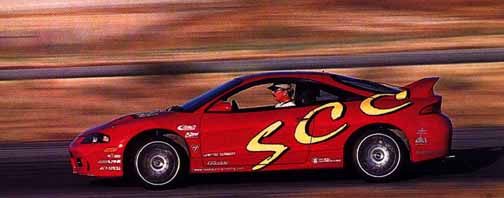
Think back to when you were in high school. There was probably a girl back then who over the span of one summer transformed herself from cute wallflower to righteous babe. Maybe at the end of her sophomore year, you noticed her, but she was still somewhat awkward. Cute, but in a little kid kind of way. Then, the first day of her junior year, she came to class dressed to kill. Her hair was styled, her dress was short, her glasses were replaced with contact lenses. After one look, those teenage hormones were pumping, and you wonder how you ever overlooked her before. The same transformation has taken place with Mitsubishi’s Eclipse. Last year, it was a cute car. A solid performer, don’t get us wrong, but with styling that presented a smiling face to the world. The Eclipse is all grown up now, with a revised nose and tail moves the car’s attitude from happy to pissed off.
While Mitsubishi changed the styling of the Eclipse to something more aggressive-and more in tune with its performance intentions-it was smart enough, to leave the good stuff alone. Which means the 210-horsepower turbocharged engine, all-wheel drive system, limited slip differential and limpet-like grip that have made the Eclipse a favorite for those tight, twisty roads we all adore are still there for us to enjoy and improve on.
Our goal for the Eclipse is not to build a drag racer, but an all-around performance car that will be equally capable on the street and on the track. We will take advantages of the Eclipse’s inherent strengths while improving on its weaknesses. Be assured that although drag racing is not the goal, more power definitely is. And you will be informed of every step of every screw that is turned on our project, Along with our sister publication, Sport Compact Car, we will show you the best ways to extract more power from the Eclipse, regardless of your budget. Naturally, big power gains cost more money, but we’re aware that not everyone has NASA-sized budgets for their own cars, and there will be plenty of information on how to improve the car’s performance without taking out a second mortgage. Keep your eyes open for our next issue, for our first installment of Project Eclipse.
Marc S – Mid 12’s! (Carlsbad, March 1998)
Yesterday at Carlsbad was a really awesome experience for me. Got some
great runs in & had some funny encounters with the Carlsbad folk/rednecks.
Carlsbad highlights for me:
First, I wanted to see if I could run in the far right lane, the one with
the short line & all the big bad-a$$ V8 trailer-queen cars that get
preferential treatment. I knew the response I’d get if I just drove into
it & asked the official if I could run there, so I walked up to him first
(so he couldn’t see I was an “import driver”) and said “This lane’s just
for those who run 12’s and faster, right?”… He said “Yep”… So I said
thanks, went back & got in the fast lane with my DSM :). A few people
looked at me funny (it must seem strange seeing a nearly bone-stock looking
DSM with a quiet exhaust driving up the fast lane) and I felt a bit nervous
& wondered if I’d get kicked… So I’m almost to the staging lanes & the
beer-bellied track official comes up to me and says “Hey, do you know what
you run?” and I said “Yep. 12’s!” and he looked at me funny, wanted to
argue, but couldn’t say anything… So he let me run. :) (Fortunately it
was a 12). So, if this isn’t great motivation for everyone to put on more
mods and hit a 12, what is? You can run in the elite V8 lane and tick off
the Carlsbad rednecks too! :)
One of the guys I raced had a built El Camino or something… I ran a 12.6
to his 12.8 and also had a much better reaction time which made it look
like I was even more ahead… He parked behind me in the lanes afterwards
and we had a great conversation… “What the hell do you have in there?”
(2 liter 4 banger). “Well how much does that little thing weigh?”
(3300+ lbs). (Pause/confusion, expected a much lighter weight, not
understanding this isn’t a Honda he’s dealing with). “JEE-SUHSSS! I saw
you jump ahead of me off the line and I’m thinkin ‘that’s a quick car but
now I’ll catch him and fly right by him… And you just kept going and I’m
saying ‘$h!t! I can’t catch this guy! What the hell?'”
The absolute highlight of the day was after making my 4th run and getting
in line for my next run, two of the Carlsbad officials walked back all
excited and started talking to me… “What the hell do you have in
there! Holy $h!t your car runs fast! We couldn’t believe how fast
you got off the line! You’re running nitrous, right?” (Then they
freaked when I said no & showed them the pretty stock looking engine
compartment). “Yeah we’ve been watching you race all day, the guy starting
the lights was commenting ‘Damn that car can go!’. Hey, what are you
doing tomorrow? You gotta come back tomorrow and race in the real races!
You could win $300!” (The emphasis on $300 made it sound like a year’s
salary). :)- Jokes aside though, several of the Carlsbad officials I
spoke to were very friendly to me & others w/ imports, irrespective of our
timeslips.
Here’s my run’s-
Run 1
1.811 60-ft, 5.257 330-ft, 1/8: 8.150 @ 83.80, 1/4 mi: 12.773 @ 103.85
mph
Beat my previous best 1/4 (12.85 @ 106mph) by a tenth, but mph’s were down
by 2
Run 2
1.743 60-ft, 5.134 330-ft, 1/8: 8.013 @ 85.78, 1/4 mi: 12.642 (mph not
shown)
With that 60 foot time, I figured for sure that would be my fastest run for
the day. MPH were back up in the 1/8th but the left lane which I was
running in wasn’t reporting mph in the 1/4 for most of the day.
Run 3
1.777 60-ft, 5.230 330-ft, 1/8: 8.092 @ 85.59, 1/4 mi: 12.755 @ 103.66
mph
Another 1.7, but not as good a run as the last one. Mph’s are way too low
and I noticed that when I shift from 3rd to 4th, it’s not pulling as hard
as it should. Though I’m running mostly 100 octane unleaded, I decide to
actually *lower* my boost for the next run to see if it will have an impact
on my MPH.
Run 4
1.735 60-ft, 5.175 330-ft, 1/8: 8.031 @ 86.60, 1/4 mi: 12.618 @ 107.1 mph
Another low 1.7 60-foot, and my MPH’s have increased substantially.
Apparently lowering the boost helped.
Run 5
1.718! 60-ft, 5.126 330-ft, 1/8: 7.958 @ 87.36, 1/4 mi: 12.525 @ 106.79
mph
Great way to end the day… Almost broke a 1.6 60 foot time (On worn-out
225/50 BFG Comp TA ZR’s). Dropped into the 7’s in the 1/8, and dropped
another full tenth off my 1/4 mile. I was working on a better 2-3 and 3-4
shift for Run 4 & Run 5 & I think it helped. I concentrated on keeping my
foot on the gas during the shift, and while in both runs I still ended up
letting off on the throttle somewhat, I kept my foot into the gas at least
part way & just jammed the shifter into gear. Surprisingly, it dropped
nicely in there w/o a fuss or a grind.
Misc notes on the runs:
I usually launch around 4000-4400rpm and drop the clutch fairly quickly
(but not a complete “drop”). In my first run it netted a low 1.8 and I had
pretty good traction. In the next run, I brought the rpm up a little
higher (4500-4600) and dropped the clutch even quicker. I got major wheel
spin on all 4’s and I think a bit of wheel hop (loud thumping noise coming
from the rear). I figured for sure that it was gonna be a crappy run, but
when I got the timeslip I had a 1.7… I continued with that method for the
rest of the day and ran consistent 1.7’s… My conclusion is that some
wheelspin on an AWD is a *good* thing. You’d think it means lost
acceleration but apparently it’s still moving you forward quite well and by
keeping the revs of the engine up due to wheelspin you stay in a stronger
power band.
Less extreme boost = better mph/ET (for me)… I had actually heard this
from another fast 2G owner & didn’t believe it at the time… I was probably
running 22-23psi initially, and I lowered that & ran better. (For me, the
16G can’t sustain 20psi past 6300rpm no matter what, but below 6300 it’s
possible). I’m assuming the higher boost is causing ignition retard, but I
don’t know if it’s because the ECU is detecting knock, or if the ECU just
doesn’t like so much air flow and is out of range…
Anyways, it was a fantastic day. Great seeing everyone again, thanks for
sharing it with me. Thanks also for putting up with all my enthusiasm
about my runs… Claim Jumpers was cool, other than Dani head
butting/attacking me every few minutes. (Grin). Some day we’ll learn to
harness her near-limitless supply of energy and we’ll power a DSM into the
9’s :)-
-Marc
Marc S – Into the high 12’s! (Carlsbad, January)
Hi all,
The Carlsbad event was great! Ok, the track is neither well-run nor
well-maintained, but the company was great & I really enjoyed the runs I
got in.
– Caravanning down from RRE was cool. About 9 cars. We managed to stay
together pretty well & kept it around 80mph. It sure was fun watching how
people looked at us & listening to the comments when we were at the gas
station. Hey, anyone up for practicing formations? We could have double
and triple lines, diamond formations (how fitting), etc! (Grin) Regarding
racing around for the last couple miles… Heyyyy I just wanted to make sure
my boost was set right :)
– Once our 8-9 cars made it there, our numbers were around 15+ cars & 30
people.
– Timeslips… I hit the 12’s! (Yahooo!) I ran a 12.86 @ 105.04 and
then a 12.85 @ 106 (best). This was the first time I was traction limited
with an AWD… I was spinning all 4 tires off the line & through much of
1st. Some of that was most likely from having dirt/mud on the tires (good
ol’ Carlsbad). I think I can knock a couple more tenths off with a combo
of a better launch (I was doing 1.8 60-footers) and by leaning the fuel out
more. With race gas, temps never got past 860 degrees Celcius, & I woulda
liked to be near 900 as I crossed the 1/4 mile line.
– BBQ… Very very nice! Mike Cornwell is the man when it comes to BBQ!
(He’s just a lamer when it comes to spelling my first name… You wonder why
I keep my last name as an “S”? So Mike can spell it!) :) The food was
great & it was cool to kick back with everyone and watch race footage.
The Carlsbad meet really woke up my racing bug… I gotta get back to the
track for more timeslips… Anyone interested in heading up to LACR in a
couple weeks?
-Marc
Peak Performer – Street Power Magazine 8/97
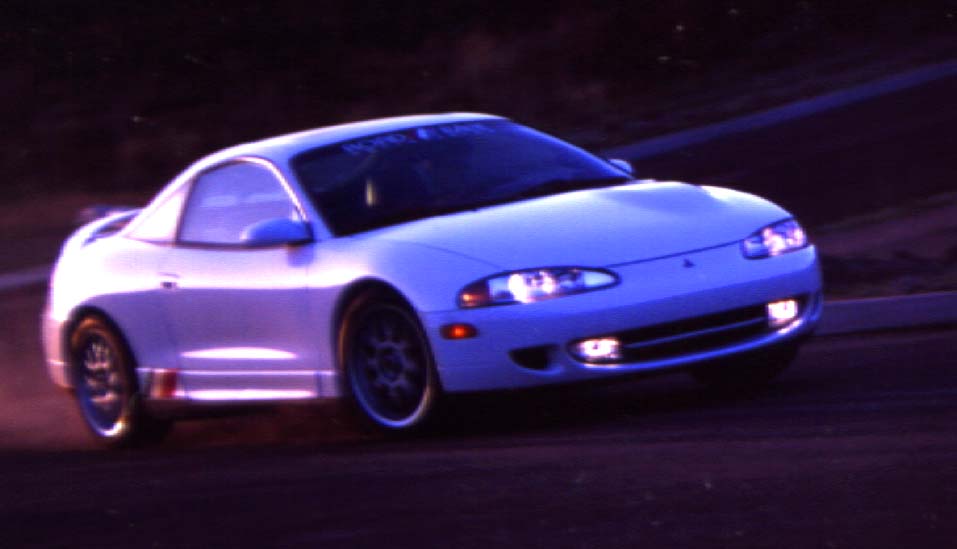
One of the most prestigious rallies in the world is the Pikes Peak Hill Climb held in Colorado every July 4. Its grueling 156 turn course stretches across 12.42 miles to the summit at 14,110 feet. At that altitude, the air is thin enough to make it difficult for humans to breath. you can imagine what it does to cars.
Conquering the Peak is no simple task, and to do well takes a combination of experience, skill and determination. Road/Race Engineering from Huntington Beach, California has been to the Peak and come away as record holders. In 1996, Kristof Huszti’s Mitsubishi Eclipse Turbo, prepared by Road/Race Engineering, took the two-wheel-drive record away from Rod Millen, who had set it in a Hyundai Scoupe a few years earlier. Huszti’s time of 13:04.03 was 12 seconds ahead of Millen’s and a significant in his – and Road/Race’s.

So what do the performance experts at Road/Race do when they’re not hill climbing?
The white Eclipse you see here is a good example. Owned by Mario Loria of Westminster, California, it at first appears to be a lesser, slightly warmed-over Eclipse. Obviously lowered, with nice wheels and tires, one could assume those and the GReddy exhaust were the only mods made to this particular GSX
Obviously lowered, with nice wheels and tires, one could assume those and the GReddy exhaust were the only mods made to this particular GSX. But there is a visual clue to more power under the hood in the form of small red, silver and black stripes on the rocker panel. Not an extraneous decoration, these are Road/Race’s colors, and are the only hint modifications to this car far surpass the superficial.
Mario bought his Eclipse after learning the aftermarket potential of the vehicle. After his purchase, he contacted Mike Welch at Road/Race and work began. The first stage was simple enough: The stock air box was swapped for a K&N performance air filter, and exhaust flow was freed up with a GReddy cat-back system.
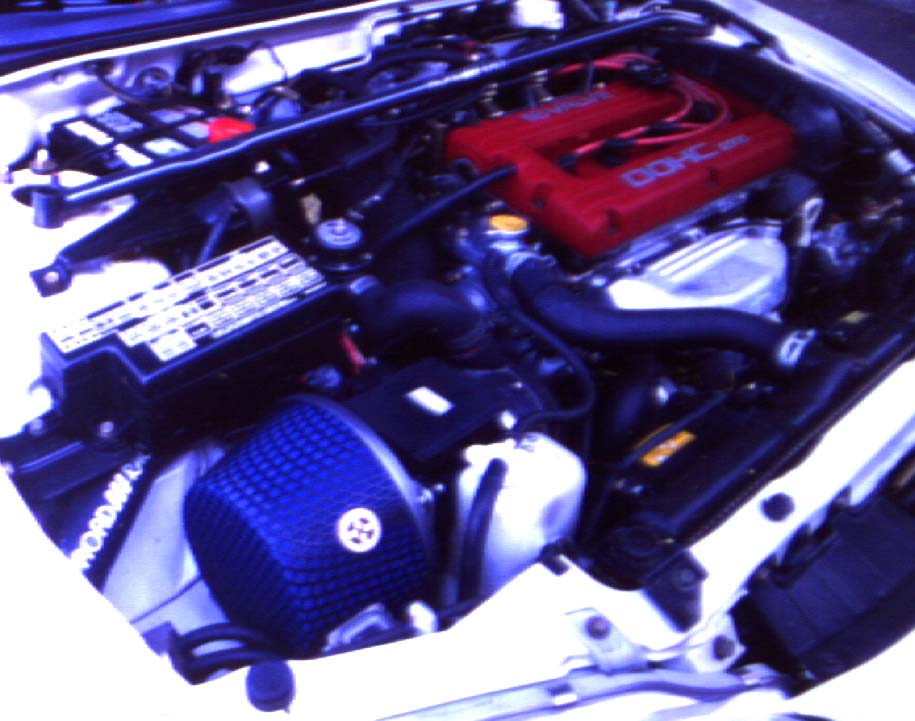
The next stage consisted of slightly more involved modifications. A GReddy S-type brow-off valve was substituted for the stock unit (which are notorious for leaking), and allowed higher maximum boost. A manual boost controller was installed in the cockpit and a GReddy graduated white-faced boost meter was mounted on the A-pillar.
But it still wasn’t enough. The stock intercooler on the Eclipse is very small, and tucked in front of the right front wheel. This was removed and replaced with a larger, more efficient unit in the same location. Bigger intercooler pipes were fabricated by Road/Race. The bumper was modified to allow more air into the intercooler, and the fender well liner was slotted to allow air to exit more quickly, further enhancing the efficiency of the intercooler. Because the engine was getting more boost and therefore more fuel the ignition was upgraded slightly with Magnecor 8.5mm spark plug wires and NGK racing plugs to help avoid detonation when the boost was cranked up.
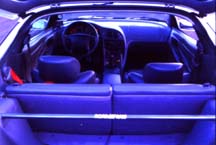
The next step involved chassis modifications to help improve chassis stiffness and therefore handling. Road/Race installed their upper strut tower braces in the front and rear, supplementing the front with an extra bar that connected the two lower strut mounts. With more power comes higher speeds, along with an increased awareness of safety. Schroth harnesses were installed as a result. Finally, a turbo timer was installed to keep the turbo from cooking itself.
By this time, the stock turbo was stretched to the limit. Road/Race substituted in a much larger TD05-16G Mitsubishi turbo, which provides about 20 pounds of boost. The compressor housing and exhaust housing were both ported along with the exhaust manifold to maximize exhaust flow. Since the bigger turbo was capable of much higher boost than the stock unit, a GReddy PRofec fuzzy logic boost controller was installed to keep better track of boost. An air fuel meter was also installed in the cockpit to keep Mario apprised of his engine’s condition.
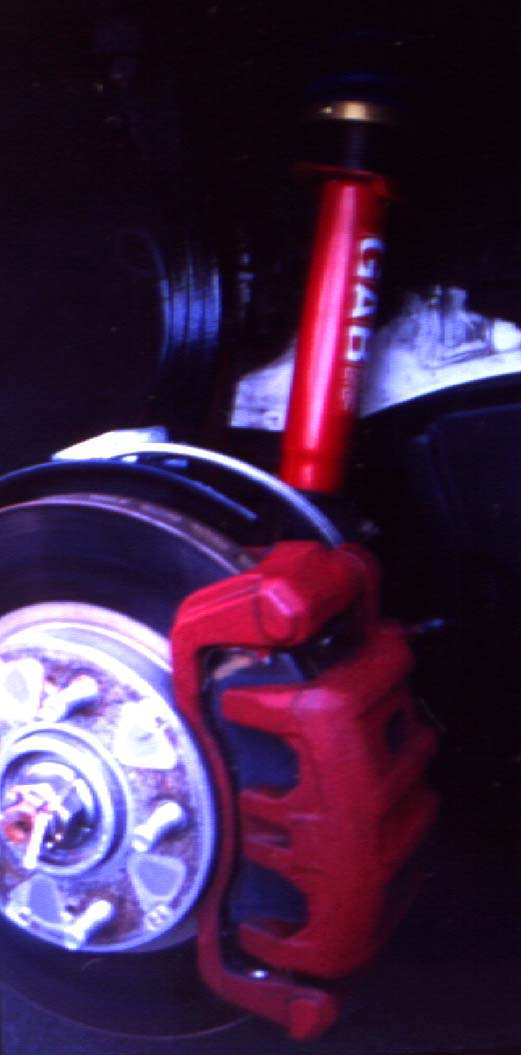
The suspension setup was proving woefully inadequate for the kinds of speeds the Eclipse was capable of. Road/Race modified a set of GAB Super HP shocks to be used as an adjustable coil-over setup. Race springs were modified for more travel, and TSW Hockenheim R wheels wrapped in 225/45ZR-17 BF Goodrich tires were put on all four corners. The brakes were supplemented with Porterfield carbon-Kevlar pads and stainless steel braided brake lines.
By now, the stock clutch had met its match, and was replaced with a Clutch Masters full-face Kevlar clutch and pressure plate. The in-tank fuel pump was upgraded to a higher-flow unit.
Because the car is all-wheel drive, it is impossible to dyno. [2011 note… we are talking 1997 So Cal with no AWD dynos available at the time :-P ] However, based on front-wheel drive cars with similar modifications, Mike from Road/Race estimates power in the 320-hp range. More importantly, the car is not unusable for the street. The ride is firm, but hardly bone jarring. Although the bigger turbo does take a little while to spool up, its not as leggy as we expected.
And when it comes on, watch out. The car launches ahead like it was fired out of a slingshot, racing to red line as fast as you can shift. Mario says he wanted a high-performance supercar he could drive every day. With their Peak performance to work from, Road/Race delivered.
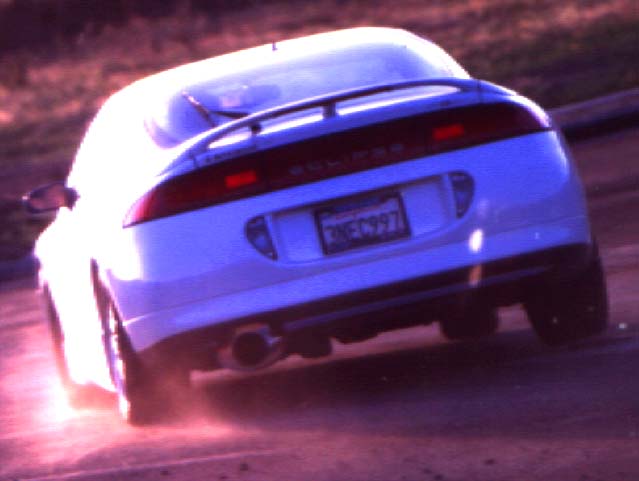
Marc S – Ferrari 355 War Story
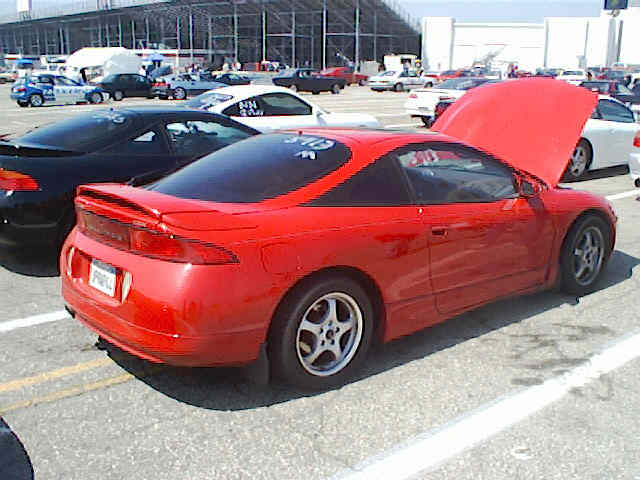
I’ve seen a lot of Ferrari 355’s around (I live in Southern California),
but have never been able to get one to race me. Until a few nights ago!
It was around 2am, I had been driving for an hour on a relatively cool
night (low 60’s). As I near my house, I see the very low, very wide
silhouette of a F355, plus a car up ahead of him with lights on top.
The Ferrari driver is driving pretty slow, maybe 40mph. I figure there’s
no chance for a race here; it’s probably a cop up ahead, and if it
isn’t, this guy is probably the typical ultra-conservative Ferrari
driver judging by how fast he’s going. Not that I was entertaining
any thoughts about beating the Ferrari! I have a 95 GSX with a stock
T25 turbo. My mods are a complete exhaust system from the turbo back,
an upper I/C pipe w/ 94 BOV, manual boost control, a RSA FR2 filter,
and no MAF honeycombs. My best 1/4 mi run to date is a 13.65 with a
1.78 60 foot time, and much slower w/o a good launch (14.0x’s with a
2.0 60 foot time.)
Luck was with me though. The car up ahead turned out to be a
rent-a-cop, and he turned off at the very next street, leaving the
two of us alone on a long deserted road. I get next to the Ferrari
(and am very obvious about it) and look over at him to try and initiate
a race.
No dice, he stares straight ahead.
Ok, only one other thing to do. I floor it and quickly get a few
hundred feet in front of him, then tap my brakes and wait for him to catch
up, daring him to take the bait. (Not that I expected him to; this is
the third F355 I’ve tried to race in such a manner).
Suddenly I hear a WWRRRAAAAAAAAAAHHH and from my rear view mirror I
watch him rocket forward. I think to myself “awesome, but now I get
to really have my face rubbed in the dirt; I’m not going to floor it
until we’re side by side, and he’ll probably just continue right by
me with his gas pedal slammed to the floor”. (It’s always so hard
to get initial timing right with a stranger in a street race, ya
know?) :).
Good luck strikes again! The guy plays fair, and brakes once he
catches up next to me. We’re side by side. I’m thinking “well,
my intercooler is probably still reasonably cool, the cool air
helps me even more than it helps him, but we’re at 35mph, I’ve lost my
AWD advantage, and he’s got 380 horsepower!! Here goes nothing,
but damn this is gonna be fun!”
We floor it. My turbo spools up almost instantly (the one nice thing
about a T25) and I rocket forward in second gear. I pull a little less
than a half a car length on him. We’re accelerating almost at a dead
heat, he’s pulling maybe a foot or two. I shift to third, it’s still
very close but he’s pulling a little more now. We go from being side-to-
side to him slowly edging out in front of me.
Ok, timeout for a comment here regarding Ferrari’s… I have a complete
3″ exhaust, my windows are all closed, and as we’re racing, I can clearly
hear his engine over mine. And a good thing it is, too! What a glorious
sound! It was almost like something out of a Formula One race. I don’t
care if you drive a 12 second car or a 19 second truck, if you can convince
a Ferrari driver to gun his engine and/or accelerate, DO IT, the engine
note is absolute music to your ears.
Back to the race. So, now that I’m in third, I realize we won’t be side
by side for much longer.. The stock T25 put up a good show, but now as
the revs increase, the boost is starting to drop, and I don’t have a good
acceleration gear left to me.. Sure enough, towards the top of third
(for me), he starts pulling more in front. By the end of third, right as
I’m about to go to 4th, he brakes. His rear bumper was a few feet in
front of my front bumper before the braking occurred. I slow down as
well and roll down my windows, but he’s either slightly embarrassed or
just being a typical Ferrari driver and won’t look over at me. Ah well.
I accelerate moderately so I can get in front of him, stick my arm
out the window and wave to him to thank him for a great race, and make a
u-turn at the next intersection to get back to my home (which I passed a
half mile back).
We raced from around 35mph to 90mph and he was barely ahead. It was
the most victorious defeat I’ve ever had and I’ll never forget the
sound of that 5-valve per cylinder Italian V8 singing its song as it
climbed through the revs. To be honest I was really surprised the
race was even that close considering AWD’s race best from a stop.
(Oh, I better say this in advance before some putz says “How can you
even think to compare a F355 to a DSM?”: This post ain’t a comparison
of the cars or a judgment on what you are getting for your money.
It’s just a war story, nothing more, nothing less.)
-Marc S
Marc S – Racing / Comparison with Eric Lu’s 95 GSX – Third Race
Just thought I’d give everyone an update on the latest modded-95
comparison that Eric & I did. As a refresher, Eric’s 95 has historically
had a lot more mods than mine, but his car hasn’t been any quicker. The
difference between this 3rd race and the prior one is that Eric replaced
his “late 95″ ECU with an earlier, non-California ECU, and added a front
mount intercooler. Here’s the current list of mods on our cars-
My 95 GSX: K&N FIPK, Magnecor 8.5mm wires, RSR 3″ Exhaust,
IM Intercooler pipe & BV upgrade, and a drilled wastegate solenoid
Eric’s 95 GSX: K&N FIPK, Nology Hotwires, Trust 2.5″ Exhaust,
custom Int pipe & BV upgrade, test pipe, Buschur 2.5” downpipe,
EVC (16 psi), secondary fuel pump, front mount intercooler,
ported exhaust manifold & O2 housing, turbo: Super60 compressor
(similar in size to a 16g), “T28” exhaust wheel w/ 10 degree clip,
ported turbo housings
We got together last night at our usual street-racing site. (Out of town
& deserted). Eric brought a couple friends which was definitely helpful
for flagging the start of each race. Temps were around 70 degrees.
Like usual we both maxxed our gas tanks at the same gas station.
We got in 4-5 good runs. The results? Well, it’s a loss I can be
happy about- Eric’s car has woken up and is finally starting to pull.
Every single run netted near-identical results. First gear and second
gear were relatively even, with Eric pulling maybe half a car or so
at the end of second. As soon as we shifted to third it was all over-
Eric’s car quickly walked away. By the shift to 4th he was usually 5-6
car lengths ahead (but once we were both in 4th he usually maintained
but did not increase his lead). We took the cars up to between 100 &
110 (I was in the lower 100’s, Eric the upper). (As a comparison,
by the way, the 600SL I raced did not pull away in 3rd gear even half
as quickly as Eric did.)
Thoughts on the results.. First, I like the fact that every run had
almost identical results with only a car length of variation at the
end of each run. I still think Eric’s car should be pulling a little
more in 1st/2nd. While clearly I can no longer keep up with Eric
like I used to, we both think he still has problems to work out.
Running beyond 16psi is apparently leaning things out and causing
temps to rise, and I just don’t see how that should be the case with
4550cc injectors, a secondary fuel pump, and a smaller-than-average
(compared to 1st gen’s) performance turbo.
The changes since this race and last were the intercooler and ECU on
Eric’s car. Eric installed the intercooler a few days before the ECU and
noticed no difference. When he put the new ECU in, his car ran
nicer (I’ll let him expand on this if he wants), and suddenly he’s
beating me by 5 car lengths. Personally, I still don’t buy into the
“major code changes” between the early & late ECU’s. When we first
started modding these 95’s, we all had problems with the boost falling
down to 10psi no matter what we did, and somewhere along the way the
ECU started getting blamed. Clearly the PSI drop is a result of the small
Garrett turbo, not the ECU. I don’t know of any cases that demonstrate
an actual performance difference between the 2 ECU’s, we only know
that the earlier one is easier to modify due to having a standardized
chip with the spark/fuel data, and the later one having all that info
integrated on a single, custom Mitsubishi chip. Still, I’m hard
pressed to explain why the ECU change helped Eric out so much. Perhaps
his original ECU had something wrong with it, or somehow locked itself into
one of those limp-modes due to his cat being bypassed. The latter
would be my best guess, perhaps the later ECU’s or California ECU’s
are more finicky about the 2nd O2 sensor. (I should like usual point out
that this *whole* evaluation is of course strictly conjecture,
to be taken with a grain of salt. We still have yet to get to a real
race track).
Other variables.. Eric & I both have stock clutches. He’s probably
losing a little of his power to a slipping clutch, which could explain
why we’re so close in 1st/2nd gear. We’re slowly killing these types
of variables though.
For our next meet, we plan to make the journey to a racetrack (Carlsbad)
and get some real numbers. We should both have performance clutches
installed by then. In addition, I plan on adding a few major mods-
a 3″ downpipe, a 3″ cat, and a 16G turbo. My hope is to kick Eric’s
butt and still be running with a cat :). I’d really like to see
Eric do runs at the track with his current turbo, and then a TD05 16G
(with no other changes); at least we could find out what kind of difference
there really is.
On a final note, there’s nothing more we can really “prove” regarding
early/late ECU’s. While I had been under the impression that I had
a Jun 95 (“late”) ECU, we checked and found that I in fact have a
Jan 95 (“early”) ECU. (This car really must have been sitting around
considering I purchased it November 95). I’m sorry I can’t bury the
myth when I go run decent numbers at the track in a couple months
(grin… thinking positive). Admittedly though, I am happy to know my
ECU is more easily modified should I wish to re-program it at a later
date.
’nuff rambling.
Marc S.
Marc S – Racing / Comparison with Eric Lu’s 95 GSX – Second Race
As a refresher, Eric (EricATCA) and I got together a few weeks ago
to see how our cars would fare against each other. We both have 95
Eclipse GSX’s. Eric’s GSX had several more mods (including a downpipe,
cat bypass, and much bigger compressor wheel in his turbo) yet the cars
were at best dead equal; usually I pulled a car length or two on him.
There were no definite answers to the “why”, but one thing that was highly
suspect was Eric’s turbo- it had no modifications to the exhaust side
yet had as big a compressor wheel as could fit in the stock compressor
housing. It definitely had heavy lag.
Since then, Eric has upgraded the turbine wheel plus give it a 10 degree
clip, ported the turbo housings, and had the exhaust manifold/wastegate/O2
sensor housings ported. We hoped the work on the exhaust side of the
turbo would make the difference, and that his car would pick up some
serious power.
We got together again this weekend, on a street outside of town where
people have been meeting for street races for at least a decade
(probably a lot longer). It’s a nice long (well over a 1/4 mile)
deserted street, and I felt comfortable racing out there in the daytime
when there wouldn’t be any other street racers around. Temperatures were
high, between 90-95 degrees. (Definitely no fun racing with windows
closed & A/C off!)
We got in around 12 runs for the day. We paid particular attention to
trying to eliminate as many variables as possible. We both filled up
at the same gas station (Chevron 92). Eric had a full tank, mine was
around 2.5 gallons shy of full to try and make up for driver weight
difference. In addition to runs off the line and rolling runs where
clutch work was involved, we also did several runs from both second
and third gear where the clutch was already fully engaged, to try and
eliminate variance in driving style. For the 2nd gear runs, we both
had the clutch fully engaged and the engines at 3500rpm when we stepped
on it. Same thing for third gear, except we did it from 3800 rpm.
Regarding boost levels, I think the runs were split around 50/50 between
Eric running at 18.5 psi & 15 psi. I have no boost control, but I have
hollowed out the nipple on the wastegate solenoid on the air box, which
allows me to spike up to 15ish psi (after which boost falls down as revs
increase).
Here’s the list of mods on the two cars. (An asterisk * denotes
changes since last time).
| Eric’s 95 GSX | My 95 GSX |
| K&N FIPK | K&N FIPK |
| Nology Hotwires | Magnecor 8.5mm wires |
| Trust 2.5″ Exhaust | RSR 3″ Exhaust |
| *Imagine Motors Int pipe upgrade | Imagine Motors Intercooler pipe upgrade (Was an HRC unit last time) |
| Test pipe | Stock catalytic converter |
| Buschur 2.5″ downpipe | Stock downpipe |
| EVC (15, 18.5psi) | Mod’d wastegate solenoid, +2psi over stk |
| Secondary (inline) fuel pump | Stock fuel pump only |
| T25 w/ Super60 compressor | Stock T25 |
| *”T28″ exhaust wheel w/ 10deg clip, ported housings |
|
| *Ported exhaust manifold, O2 & Stock manifold/housings wastegate housings |
As for the results… Unfortunately they are disappointing and create
more questions than they answer. The cars were very equally matched.
A couple times Eric pulled ahead of me by 0 to 1.5 car lengths, a couple
times I pulled perhaps a car length on him. Most of the time we were very
equal, with the person who happened to get their foot on the gas a
millisecond before the other person getting a nose up. I think the times
I got a little ahead were usually due to my turbo spooling up just a hair
faster (not including the other factors I’m about to mention), but
surprisingly there isn’t much more lag on Eric’s turbo than on mine. I’m
sure all else equal there is more lag there, but the downpipe, test pipe,
and ported exhaust manifold seem to offset the additional lag created by
the bigger wheels.
This time around I took Eric’s car for a drive to compare how it felt to
mine, so my comments re: lag are based on driving his car and then driving
my car.
Ok, now to the “other factors”.. We have some unknown variables here that
pretty much make this weekend’s testing moot, other than to say that
currently our cars are still pretty equal, whatever the reasons. The
first variable is a slipping clutch. Eric’s clutch does have a bit of
slip (When I did some harder shifts in his car, it was not as crisp as in
mine.) I never saw any major slippage, but minor slippage may be occurring.
Eric will be putting a Centerforce D/F in soon, so that should eliminate
the clutch variable. Ok, everything that follows is pure (educated?)
guesswork.
“Variable #2” is a complex one. It’s ECU related. It seems like
Eric’s ECU is retarding his timing, big time. In the races that started
in lower gears (1st, 2nd) where he pulled a little on me or kept up with
me, he was set at 15psi. When he was set at 18.5psi, I usually pulled
a car length on him. In the higher gear races (starting in 3rd gear),
using 18.5psi didn’t seem to hurt as much but it certainly didn’t help
much either. This is a definite sign of a problem, 18.5psi should have
given him a lot more power, not hurt him. He has a big compressor
wheel, going to 18.5 psi should show good gains. He hasn’t played with
the timing on the car yet, but is going to try retarding it a little
to see if that makes a difference.
I’m curious, by the way, if anyone knows the effects that the 2nd
O2 sensor behind the cat (in this case, test pipe) might have on the
ECU?.. Could running a test pipe from an ECU point-of-view be hurting
Eric? (I’m unsure if he even has his 2nd O2 sensor installed?…)
Anyways, to me, I don’t think it’s a matter of the performance parts
on Eric’s car slowing him down or not providing good performance. Take
a look down the list of mods on his car & you’ll note that every
part on there has been proven by many DSM’ers to increase performance.
And I have seen a 95 with a turbo nearly identical to Eric’s run some
impressive 1/4 mile times. A better clutch might help things a hair,
but there is something significantly wrong with how things are running.
What worries me is that there aren’t a whole lot of things to play with
to try and correct the problem. Any thoughts on the matter are
appreciated!
That about wraps it up. We plan to get together again in a few weeks
when the CF DF has been broken in, and after making some sort of change
(ignition retard?) that seems to make a power difference.
Thanks again Eric!
-Marc
Marc S – Racing / Comparison with Eric Lu’s 95 GSX – First Race
This weekend Eric (“EricATCA”) and I got together to compare 95’s.
(He has a T25 turbo with upgraded compressor wheel (Super 60)
& since I am in the market for a performance turbo, I wanted to see
how it ran). Eric’s a great guy, and it was a fun afternoon.
The performance results are somewhat surprising…
Here’s a description of the 2 cars-
Eric’s 95 GSX My 95 GSX
————- ———
K&N FIPK K&N FIPK
Nology Hotwires Magnecor 8.5mm wires
Trust 2.5″ Exhaust RSR 3″ Exhaust
HRC Intercooler pipe upgrade Imagine Motors Intercooler pipe upgrade
Test pipe Stock catalytic converter
Buschur 2.5″ down pipe Stock down pipe
EVC (was set at 16psi) Stock (no boost control)
T25 w/ Super60 compressor Stock T25
I really expected Eric’s car to leave me behind. The test pipe &
downpipe should have made a nice difference (25+ hp?), not to mention
consistent & higher boost from the EVC, and a bigger turbo flowing
cooler air.
The results though?… I was usually 1-2 car lengths ahead for the
duration of each race! The pattern was as follows- as soon as we
both stomped on it (almost all races were done from a roll)
my car would pull a little ahead. My smaller compressor wheel got into
boost a little earlier, enough to give me a car length usually. At
“upper midrange” we were around even, at upper revs Eric would start
to pull a little. When we hit second gear, it was “1st gear all over.”
I’d pull a little further on him initially and pretty much manage to hold
most of my gains. Towards the higher rev range he’d probably close a
little distance. We took it to the top of third gear once or twice,
but the results were still pretty much the same, the nose of his car
was behind my bumper from a few feet to 1.5 car lengths.
I should mention that also having been in his car as a passenger,
it definitely pulls a harder than my car from 4500rpm on up. I think
with a little better shifting the races would have been closer. But
that would mean 2 cars dead even when one has more mods..
Now, trying to sort out the why’s… Clearly a performance downpipe and
a test pipe give better performance and were helping him. Though the
EVC probably helped a bit as well (a little more boost + wastegate
held closed longer) for simplicity’s sake I’ll ignore any gains the
EVC should have been giving his car. That leaves: the Trust 2.5″
exhaust vs. my 3″ RSR exhaust, the HRC Intercooler pipe upgrade vs.
the Imagine Motors upgrade, and the upgraded T25 vs the stock T25.
I figure the RSR 3″ had to have helped me for some of that. We both
noted that in addition to the difference in pipe diameter, the Trust
exhaust has a relatively sharp bend near the muffler, and necks down
to 2 1/4″ where it meets the test pipe, whereas the RSR is very straight
throughout, and necks down to 2.5″
Intercooler pipe upgrade… I don’t feel as comfortable making any
claims here other than that the HRC upgrade only upgrades the area
from the intercooler up to the blow off valve, whereas the Imagine
Motors upgrade continues up from the blow off valve to the throttle body,
and replaces the stock throttle body elbow (which has a nasty sharp
edge/kink inside it) with a bigger/smoother elbow.
Eric & I felt that the T25 made the big difference. Upgrading
the compressor-side-only meant more lag, and because the exhaust side
stayed stock, it probably had too much backpressure building up there.
At the least the turbine wheel needs to be clipped. More likely the
turbine wheel needs to be upgraded as well. I’m unsure on whether
the compressor wheel shouldn’t be downsized as well to perhaps a
standard 60 wheel.
Eric will be upgrading the exhaust side of his turbo soon, with a bigger
turbine wheel and a clip. We’ll get together again and see exactly how
it affects things. Though I’m looking to upgrade a few items on my car,
I’m going to hold off until we can do this comparison. It’s important
to see what works and what doesn’t. I’m hopeful (and I’m sure Eric is
as well) that when his new turbo goes on and we meet again, that his
car will soundly take mine when we race. I’d hate to think that a
TD05 is the -only- way to go. I’d like to keep the T25 if possible
for the sake of warranty. So far all my mods are ok with my dealer,
but putting on a different turbo would probably change all that.
(Thanks again Eric!)
-Marc
Sport Compact Car Magazine – From The Cockpit – 1994
Sport Compact Car Magazine 1994 – Reprinted with permission
By Mitch McCullough
We were halfway through the eighth stage of the Lake Superior PRO Rally and things weren’t going so well. A misfire in the engine, caused by a faulty throttle position sensor had reduced our power. Then a problem with the clutch linkage made shifting difficult. So I wasn’t too surprised when a Mazda 323 GTX piloted by a fast local driver started catching our 323 GTX.
Our PRO Rally effort had been going extremely well up to this point. I had bought the partially prepared 1988 Mazda 323 GTX just before the 1993 season started, and codriver Scott Webb and I had won the 1993 California Rally Series championship. We had raced against some strong competition and it was the first time in the 18 year history of the series that a driver had won the championship in his rookie year. Webb and I were each named Rookie of the Year.
We went on to clinch the 1994 SCCA Southern Pacific Divisional Championship, which starts and ends on Labor Day. This title earned us an invitation to compete against Divisional champions from around the country at the Press On Regardless PRO Rally in Michigan’s Upper Peninsula, a vast wilderness of deer, trout and the kind of dirt roads all rallyists dream about.
This year, “the oldest, meanest, toughest” rally in America was renamed the Lake Superior PRO Rally. The Detroit Region SCCA, which had organized the Press On Regardless for 47 years, opted to pass the event on to the more strategically located Lake Superior Region, but retained the POR name for a road rally.
Despite the name change, it was the same event with many of the same dedicated workers and the same phenomenal roads. This year’s rally comprised 165 miles of special stages with another 288 miles of transits.
Stage Eight, called Far Point, began as a fourth and fifth gear run through the dark forests. The powerful driving lights filling our mirrors were mounted on the GTX driven by Craig Sobczak of nearby Marquette Mich. Our clutch would not fully disengage, so shifting was difficult. I was staying in fourth gear, lugging out of the slower corners and not shifting up to fifth on the longer straights, trying to avoid damaging the new close ratio gearbox. We had decided to simply drive for the finish.
It was a dark, rainy night and there was still a long way to go. I had lost my enthusiasm for the high speed stages. “You were driving like an old lady,” Webb said later.
When Sobczak got close, I turned on the right blinker and moved toward the right side of the dirt and gravel road, slowing to 70 mph to let him by. But watching Sobczak throw his GTX through the high speed corners inspired me to go faster. “This is like road racing,” I shouted.
Still, Sobczak was pulling away, dropping momentarily from sight around a bend. On the next straightaway we saw that his left taillight lens was missing and the gap between us had narrowed. Then we saw some tracks in the road where someone had skidded toward the ditch. “He went off and tagged the bank!”
Sobczak had slowed only slightly, but we had turned up the wick and cut our distance. Then Webb called an acute right hand corner where we turned off the smooth county road onto a muddy, slimy trail that went up a hill. A crowd of spectators had gathered, standing behind a yellow banner to witness this challenge.
As Sobczak turned in, his 323 bogged in the muddy turn. Seizing the opportunity, I turned inside and went by him, slinging mud in all directions, and accelerated away. Cameras flashed, the crowd cheered-this was racing!
The path we were now on was composed of the slipperiest mud I’d ever seen. Suddenly, I was switched on and the car seemed to be working much better at the lower speeds. We were shifting from second to third and back again, grinding gears, braking in the muck for the tight turns, the car fighting every change of direction as we squeezed through the trees on the narrow path, grappling for grip. We pulled away from Sobczak and when we finished the stage we were ecstatic. We knew we had lost the stage to Sobczak, but we felt as if we had won the race. It was the highlight of the event.
We failed to press on, however. On the next stage we hit a big rock that cracked the sump, draining our engine’s life blood and ending our race through the dark north woods. Veteran John Buffum won the rally in Paul Choinere’s Audi Quattro. Meanwhile, Rhees Harris from Vemmont beat us to take the overall Divisional driver’s title in the Open 4WD class.
I was surprised at my lack of disappointment over failing to finish the event. It had been a great season and we had prepared well, given our meager budget. In nearly two seasons of PRO Rally, we had not suffered any mechanical problems and were happy to gang them all up in one event. And at the awards breakfast, we learned Scott had amassed enough points to take the overall co driver’s divisional championship in our class!
How We Started
I bought the 1988 323 GTX from Bill Morton, a New Zealander who helped prepare Rod Millen’s 323s for the Asia Pacific series. He had built the GTX for his own rallying pleasure and was forced to sell it after taking a job with Toyota Team Europe. He lamented-and I reveled-in the fact that he had only tested the car once and had never gotten a chance to race it.
But Morton had prepared it well. He removed the interior except for the original front seats, door panels and dash. He and Mike Welch welded in a superb roll cage, reinforced with gussets, and painted the interior refrigerator white. Headroom abounded. They bolted on a sturdy skid pan and numerous mud flaps. And they installed an HKS manual boost control and PFC F CON fuel controller to extract additional horsepower from the tired motor.
But the big feature was the suspension: Morton had managed to procure a rally suspension that had been on one of Mazda Team Europe’s 1988 World Rally Championship cars. This suspension was much stronger than the stock setup and the spring and damping rates provided phenomenal handling over loose, rough surfaces. The rally suspension provided adjustable spring perches for varying the ride height and Bilstein competition dampers.
I knew the basic preparation was right. I knew there was a good divisional series in Southern California. I knew I had to have the car. So I bought it, figuring I’d run a few local events. Besides, I reasoned, the car was street legal so I could always use it to run around town.
A mere eighteen months later we had won two championships and had posted finishes in the top five nationally. My experience in autocross, road racing and blasting down the dirt and gravel roads of Eastern Washington and Northern Idaho seemed to have paid off.
The real key to our success, however, was sound car preparation, a crack crew chief and consistent driving.
Rallying What It Takes
Probably no other motorsport requires the combination of car preparation, driving ability, endurance and reliability demanded by rallying. Triumph in the face of adversity is the battle cry of the successful rallyist.
The key is car preparation. A competitive rally car must be fast, tough and reliable. It must be driven consistently fast, with more emphasis on consistency than on speed. PRO Rallies often comprise more than 100 miles of special stages and another 200 miles of transit legs-quite a bit longer than a 20 minute regional road racing event or three minute autocross. Many times we’ve seen drivers go extremely quick in the early stages only to break or crash later in the event. We’ve been guilty of this ourselves.
The car must be prepared to finish events. Too many teams spend too much money on horsepower, overtaxing the gearbox, suspension and brakes. And assuming you can’t afford to spend more than $30,000 for a six speed gearbox, the engine must offer a generous rev range with enough torque at the low end to dig the car out of sandy switchbacks.
Preparing The Rally Car
Our 323 suffered two major crashes during the season. In the first one, I mistook the little 323 for a stadium truck and launched it 12 feet into the air at a rally sprint on the Glen Helen, Calif., motocross facility, landing the car on the front bumper. In the second one, we drifted off a sweeper at the Prescott Forest PRO Rally, rolling four times down the mountain.
Most of our development efforts coincided with repair work from these crashes. Road/Race Autosport, a race preparation shop run by Scott Webb and Mike Welch in Los Alamitos, Calif, prepared the car.
Welch replaced the body work and painted the car white with a scheme reminiscent of Mazda’s 1988 World Rally Championship 323s. Road/Race replaced damaged and worn suspension bushings, lateral links, trailing arms, differential mounts and engine mounts using components from Mazda’s Competition Parts division.
Nonslip pedals help a driver keep his feet in place on those rough stages.
The benefit of strut bars is sometimes called into question, but we have witnessed their virtues. The stress of rallying was causing the front strut towers to rotate and gravitate inward. We had gained two degrees of camber and a new fender was off by more than an inch when we tried to match it up to the inner liner. Road/Race solved this problem by designing a front strut bar to tie the towers together. Most strut bars on the market are made of small diameter tubing and often are bent in several locations for clearance reasons, allowing them to flex under the high stress loads. The Road/Race bar is a highly rigid, yet lightweight design with larger diameter tubing and minimal bending between the struts to prevent any flex.
To reduce brake fade and improve reliability, we installed semi metallic brake pads, racing fluid and braided steel lines.
Most PRO Rally cars use a rally computer I to help their drivers keep on time.
Extensive underbody protection is required on a rally car to fend off rocks, tree limbs, flyovers and other hazards, particularly on the rough special stages of the Southwest. Morton’s skid pan protected the sump, and Road/Race added numerous guards made of carbon fiber to protect other areas, while clever metal skids were welded to the leading edges of differential mounts, exhaust joints and important bolts. And all those mud flaps aren’t just for snazzy good looks. A season of flying rocks is like a sand blaster working around the clock that will gradually grind suspension pieces away to nothing. So Road/Race installed mud flaps made of LPDE plastic behind each wheel. in front of the rear trailing arms next to the lower timing chain cover and anywhere else that was exposed to flying rocks. We’re constantly replacing them.
The car came with safety harnesses. so inside we added a rally computer, a pair of racing seats, a padded box for our helmets, window nets on both sides, an intercom and a co-driver’s map light with a red lens-a white light is distracting for the driver and is too bright for the white paper in the co-driver’s route book.
Road/Race replaced the bracket holding on our driving lights with an attractive pod for our massive, new PIAA fog and driving lights. The pod keeps the lights out of harm’s way, locates them out of the cooling air for the engine and can be quickly removed or installed for daytime and night stages. It also reduces vibration, which can be distracting.
We fitted 15 inch DP Enduro wheels shod with Michelin rally tires. Our competition tires are size 14/62-15 L4, meaning they are 140mm wide, 62cm overall height and 15 inches in diameter using compound No. 4 on an L-shaped block tread design. With four-wheel-drive cars, particularly those with locked differentials, it’s important to use the same size tires on all four corners. Otherwise the drive train will fight itself, possibly leading to an expensive repair. While rally tires may look like snow tires, they are really very sophisticated and provide surprising grip on pavement and are nothing short of phenomenal on dirt. The extremely strong sidewall construction of the Michelins makes them incredibly resistant to punctures from sharp rocks.
We try to start an SCCA National PRO Rally with six new tires. In 12 events, we’ve had only two punctures (both on the same stage!) and usually finish an event with four serviceable tires and two new spares, all of which can be used for the next event. This provides us with a complete set of spares in case the event is particularly brutal on tires. To be totally prepared, we should have gone to Michigan with ten new rally tires, six snow tires and six Showroom Stock tires for the tarmac stages. But we couldn’t afford to be totally prepared and, in the end, that was okay.
Halfway through the first season I asked MFI Power in Garden Grove, Calif, to rebuild the engine. John Mueller focused on a broad powerband with strong low-end torque rather than maximum horsepower. With the stock gearing, we had often found ourselves lugging out of sandy, uphill corners at the bottom of second or third gear.
For the most part, Mueller rebuilt the engine to stock specifications, porting and polishing where possible. However, he lightened the crankshaft by five pounds and dropped another nine pounds off the clutch and flywheel assembly to maximize off boost performance. He knife-edged the crank and machined the flywheel from aluminum stock. We added Torco 5W30 synthetic racing oil to provide maximum protection and minimum friction. We think Torco might have saved the engine when we lost all the oil in Michigan.
The result was an estimated 190 horsepower compared with 135 hp stock. We selected a Centerforce competition clutch and pressure plate designed for an RX-7 to handle the increased horsepower and the abuse of rallying. Road/Race designed a pair of hood ducts to extract hot air from the engine compartment. These reduced engine temperatures at the hot weather events, and we could see the hot airwaves coming out of the engine while waiting for the start of stages.
Our most exotic piece of equipment, a close ratio competition gearbox, was installed late this past season. Our top speed has dropped to somewhere in the 90s, but the gearing has really paid off
Competing for an SCCA National PRO Rally championship is not cheap and should not be considered a grassroots motorsport any more than IMSA Firestone Firehawk is grassroots road racing. However, it is possible to run a Divisional series or selected National events on a budget. For my money, there’s not a more exciting or fascinating form of the sport available.
When he’s not racing in PRO Rallies, Mitch McCullough is involved in motorsports public relations for various companies.
How Not To Take A Fly-Over
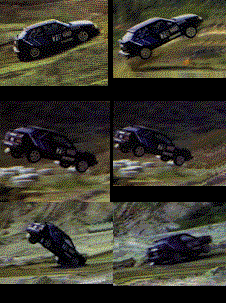
By Mitch McCullough
Mike Welch, my crew chief, is a master fabricator. A real body man. A regular McGyver. Maybe that was in the back of my mind. Or maybe I was frustrated at dealing with the big D. Or maybe I just like to show off – that’s what rallying is all about, after all.
Whatever it was, I had decided to take the jump flat out.
The physics of the situation seemed to have eluded me: Glen Helen Off-Road Vehicle Park just north of San Bernardino had been designed for off-road buggies and trucks, race cars with suspension travel measured in feet. I was sitting in a Mazda 323 GTX, a cheap econobox. That it had a turbo, four-wheel drive and a fantastic factory rally suspension was of no consequence on the big hump I was about to attack.
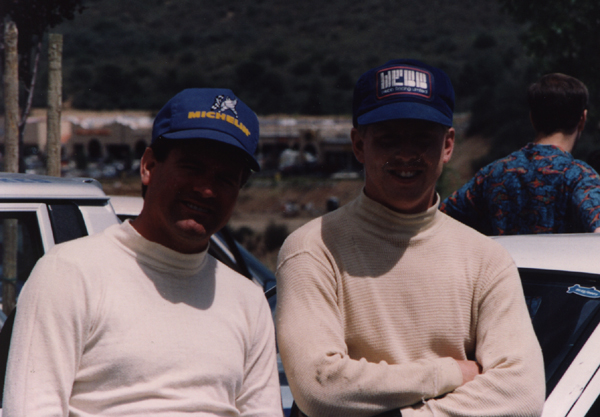
While walking around the course, I foolishly came to the conclusion that the big hump could be taken without braking. I mean, that’s what Rod Millen would do, right? Or am I thinking about Rod Hall? Anyway, the closed circuit took only five minutes or so to complete and it was a hoot. We’d be topped out in third gear on a straightaway, brake hard for a 180-degree turn, slide sideways through a 70-mph sweeper, then brake hard for the big hump. The rest of the course went considerably farther, but I would not be exploring the rest of it that day.
I sat in line, peering through my helmet as each rally car took its turn. The suspension of the first car got light as it went over the hump. “Whoa” went the crowd in the stands. The next car caught a little air, maybe six inches. “Yes!” shouted the crowd. As I watched, I thought: “Why are they braking so hard for that jump?” Beside me was co-driver Scott Webb, who had some sort of misplaced, irrational, idiotic faith in my driving abilities.
We pulled up to the start line. On cue, the starter draped a green flag over the front of the windshield and shouted, “Five! Four! Three! Two! One!” Then he yanked the flag up and quickly stepped back from the car. “Go!”
I stood on it and all four knobby Michelins twisted in the dirt. I grinded it on the upshift to second, but otherwise it was a good launch. I braked for the 180-degree turn and slid around a giant earth-moving tire. We slid to the outside as I accelerated out of the turn, but I stayed with it opening up the steering wheel to keep the speed coming on. As we approached the sweeper, I lifted, turned in and got back on the throttle. The car pivoted and slid around the corner, all four wheels slinging dirt. “This is going to be a good run,” I thought.
As we approached the jump, I lifted off the throttle where most people had been braking. We were doing about 65 mph. A cry crackled in my intercom: “Oh shit!” I stepped on the throttle again as we crested the top of the jump, thinking that would keep the nose up.
The little GTX jumped toward the heavens. Observers said there was at least 12 feet between the bottoms of the tires and Mother Earth. From inside the car, it seemed like the sky darkened as we crested the upper edge of the atmosphere. Our poorly designed rocket hit its apogee, then began the long ascent back to earth. When the ground loomed directly ahead I began to realize I may have overdriven just a bit. “Oh!” the crowded shouted. “What was he THINKING?”
It was a tremendous impact. The car landed on the front bumper. The radiator ripped in half, the hood crumpled, the bell housing cracked, the front wheels bent and most of the front clip was destroyed. Instead of going end over end, the car came to an abrupt halt and bounced back onto its wheels.
I looked to the right as the dust settled. “Are you okay?” “Ooof” was the only sound that came from the other seat. “Ooof.” Scott felt like he suddenly had a mouthful of sand. It was later determined that that was the enamel from all of his teeth. The emergency crew loaded us up on stretchers and carted us to the hospital where we spent a long, boring, humiliating day getting X-rays. We had stiff necks, I had bruised pride and Scott spent a fortune on dental work that year. Mike filmed the whole incident and later had the audacity to put it on his Web site, but the view from inside the car felt far more dramatic than the video portrays.
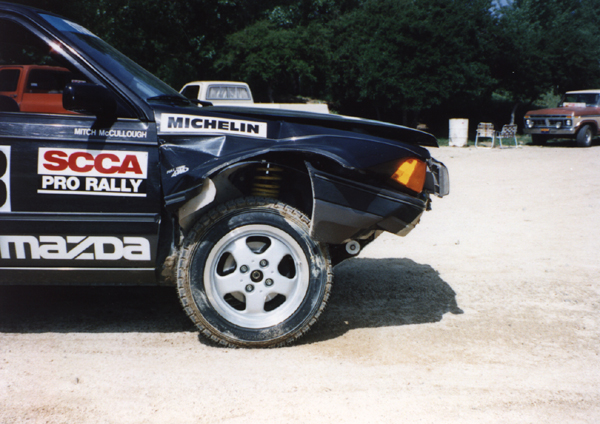

Mike quickly rebuilt the car in the Road/Race facility, replacing or repairing everything ahead of the windshield. We went on to win the California Rally Series championship that year. It was 1993 and we each earned Rookie of the Year titles. The following season, I drove off a 500-foot cliff in Arizona, rolling five times and stopping against a bush 100 feet down. The car looked destroyed, but we winched it to the top of the mountain and Mike had it back in the rally the following morning. We went on to win the 1994 SCCA PRO Rally Southern Pacific Division Championship in Open Class.
But that’s another story.
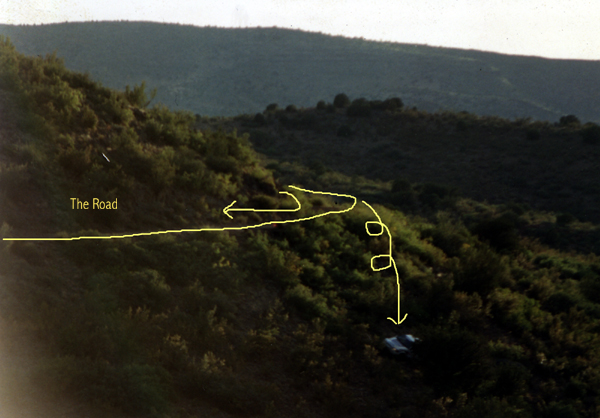
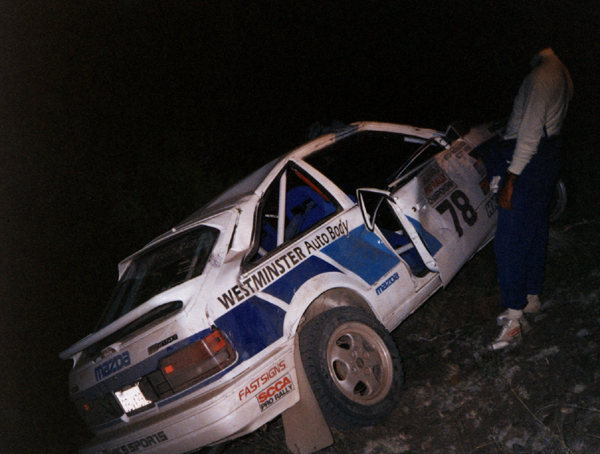
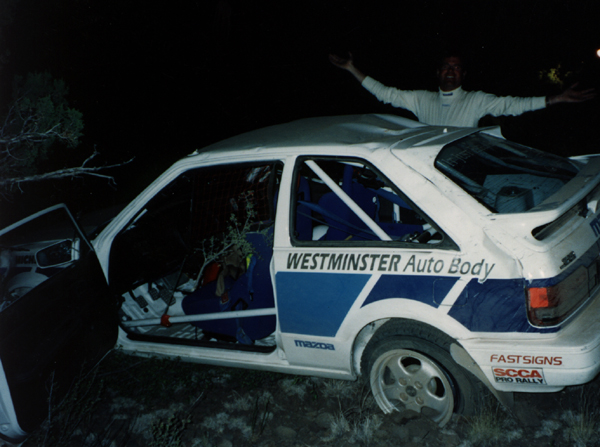
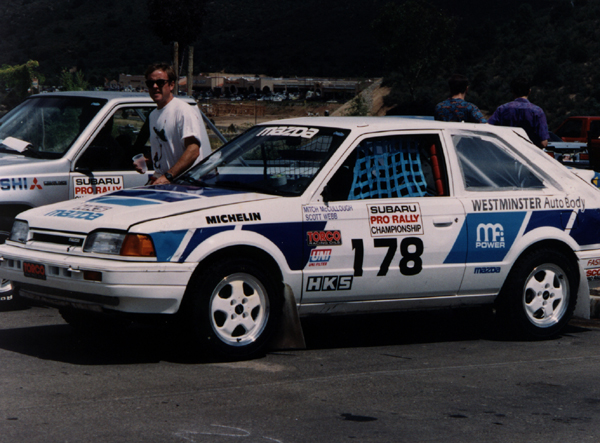
McCullough is a contributing correspondent to Field & Stream, AutoWeek, Sport Compact Car and European Car. He edits a car-buyer’s guide that can be seen at www.newcartestdrive.com. He now brakes for fly-overs.
Coming soon, the Co-Driver’s Version:
“It wasn’t my fault”